Article MT052
Walter Pardon
Put a Bit of Powder on it, Father
[Track List] [Introduction] [Walter Pardon] [In his own words] [Song tunes] [Recorded legacy][Knapton Drum & Fife Band] [Personality] [The Songs] [Discography] [Repertoire] [78rpm Listing] [Credits]
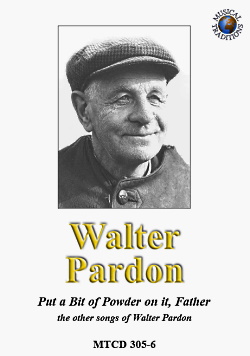
Musical Traditions' second 21st century CD release, a Double: Put a Bit of Powder on it, Father ... the other songs of Walter Pardon (MT CD 305-6), is now available. See our Publications page for details. As a service to those who may not wish to buy the records, or who might find the small print hard to read, we have reproduced the relevant contents of the CD booklet here. As usual, photo credits can be seen by hovering the cursor over the picture.
A word of warning: as this is a Double CD production, and our most comprehensive to date, the booklet is pretty big - 28 pages in all - so this 186KB file may take a while to download!
 MT CD 305:
- Cupid the Ploughboy
- A Country Life
- The Poor Smuggler's Boy
- I'm Yorkshire Though in London
- Seventeen Come Sunday
- The Parson and the Clerk
- Blow the Winds I-O
- Hold the Fort
- All Among the Barley
- Black-Eyed Susan
- Caroline and Her Young Sailor Bold
- Lord Lovel
- The Skipper and his Boy
- Thornaby Woods
- An Old Man's Advice
- If I Were a Blackbird
- The Bonny Bunch of Roses-O
- The Green Bushes
- Polly Vaughan
- The Saucy Sailor
- Little Ball of Yarn
- The Huntsman
MT CD 306:
- Put a Bit of Powder on it, Father
- The Cuckoo
- Old Joe the Boat is Going Over
- Cock-a-Doodle-Do
- The Harland Road / Wheel Your P'rambulator
- Ben Bolt
- Uncle Walter's Tune
- Two Lovely Black Eyes
- Alice Grey
- Rosin-a-Beau
- Not for Joseph, Not for Joe
- The Old Armchair
- The Marble Arch
- Wake Up Johnny / When the Cock begins to Crow / Saving Them All for Mary / Down by the Old Abbey Ruins
- The Mistletoe Bough
- On a See-Saw
- Your Faithful Sailor Boy
- Here's to the Grog
- Nancy Lee
- Up the Chimney Pot / Slave Driving Farmers / Bound to Emigrate to New Zealand
- Husband Taming
- Uncle Walter's March
- If I Ever Get Drunk Again
- Naughty Jemima Brown
- The Dandy Man
- For Me, For Me
- While Shepherds Watched
In 1999, Topic Records asked me to write the notes to their forthcoming Walter Pardon CD - A World Without Horses (TSCD514). I had not been involved in the production of the album, nor had I chosen the songs that were to be included. The original producers, Jim Carroll and Pat MacKenzie, had originally hoped that Topic would issue a double CD using many of their recordings of Walter. It seems that Topic felt that these later recordings failed to show Walter at his best and so Jim and Pat withdrew from the project, leaving Topic with a single CD that was without notes or documentation.
Most of the recordings on this CD had been recorded either by Bill Leader or myself and I found that listening to Walter again brought back many memories of him. I also rediscovered pages of notes that I had made whilst talking to him, and these were used as the basis for my sleeve notes.
But I was not able to incorporate all this material into the sleeve notes, and so I have selected and edited some of my notes into several of the sections which follow, in the booklet to this MT production:
Walter's Recorded Legacy outlines how Walter's recordings were made and includes some impressions of what it was like to record him.
The Walter Pardon Discography lists all of Walter's recordings that have been issued on record albums, cassettes or CDs.
The Walter Pardon Repertoire contains the titles of 182 songs we are aware that Walter knew. Details are given of which songs were issued on commercial recordings. Where the word 'tape' is shown after a song title, this indicates that an unissued recording is known to exist.
The Listing of Walter's 78rpm gramophone records includes of all the records that were in Walter's home in 1979. Mention is made of a few of these recordings in the notes to Topic's A World Without Horses.
Michael Yates
Berwick-upon-Tweed, February, 2000.
The recent history of this pair of CDs - the start of which can be seen above - is strangely convoluted. Almost two years ago, after parting with Topic, Jim and Pat asked me if I would be interested in releasing the 'second' CD - and I readily agreed. We exchanged a letter or two, but they then got involved in a protracted move to Ireland which seemed to take up most of the summer. I phoned them several times afterwards, but it seemed clear that they had lost motivation for the project.
Some months later, while talking on another subject with Mike Yates, the second CD got mentioned and he suggested that he could do one quite easily. Again, I readily agreed. The next thing I heard was that Topic had reinstated the second CD - consisting mainly of Mike Yates recordings!
Some months later … I heard from another source that Topic had decided against the second record as the copyright to four of the Bill Leader recordings they wanted to include was owned by Dave Bulmer of Celtic Music, and thus that its production costs would be too high. Back to Mike Yates … we agreed that MT would, again, publish the record.
So we had a full CD-R minus four songs. Mike sent me lists of all his Walter Pardon recordings (now archived at the NSA, with CD-R copies at the VWML), and I selected about eight that I thought would be suitable. I then asked Malcolm Taylor (VWML's Librarian) to send me copies, and he asked Andrew King to do the transfers. I'd suggested that maybe he'd like to fill up the CD-R with other songs while he was about it … and so, a week or so later, a second CD-R arrived.
It was immediately apparent that I could not, despite the likely consequences, reject very much of this material - it was too good; too interesting! Then a third CD-R arrived from Andrew King … an MT double CD became inevitable, and despite all the work involved, it has been an extremely enjoyable experience!
What we have produced here is intended to be a companion to the other available Walter Pardon releases. These two CDs contain pretty well every song which Mike Yates recorded from him and which is not currently available on CD on another label. Obviously, this has meant the inclusion of some (not many) fragments, and songs which would never have seen the light of day on a commercial release - in many cases they show a very different Walter Pardon from the one placed before the public by other record companies. It is our hope that they paint a more realistic picture of the man and his music - perhaps reflecting on that of all traditional singers? - than is often the case.
In deciding a running order for the songs, we agreed that we should try to make CD 1 a more conventional selection - one which the typical folk music enthusiast might find most acceptable (we, too, have to think of sales to some degree) - while the less well-known songs, melodeon tunes and fragments would occupy CD 2. We hope that this one will be the more interesting to regular readers of Musical Traditions Internet Magazine.
The Knapton Drum and Fife Band article was written by Walter Pardon himself, and originally published in Folk Roots magazine, No 28, October 1985. The other sections of this booklet are written by me, aided by quotations and information as indicated in the Credits section.
Rod Stradling
Stroud, May, 2000
Walter William Pardon lived all his life in the redbrick farm workers' cottage where he was born on 4th March 1914, in the village of Knapton, Norfolk. His parents were Thomas Pardon (1877-1957) and Emily, née Gee (1874-1953).  All the male members of his family, on both sides, had been farm workers of one kind or another for as far back as anyone could remember, so young Walter was unusual in that he was apprenticed at fourteen to a carpenter in the village of Paston, and spent all his working life as a carpenter, interrupted by four years in the army (again as a carpenter, at Aldershot) during the Second World War.
This was by no means the only unusual thing about him … to begin with, he was an only child - a rarity in that time, place and social stratum. Perhaps he enjoyed the solitary life, and the independence it brought, since he remained a bachelor all his days. But the most remarkable thing - perhaps almost unique for a traditional singer - was that he rarely if ever sang outside the family home. Yet he kept a huge repertoire of songs alive in almost total isolation for over 20 years, between the last of the family singing sessions and his being 'discovered' by the 1970s' folk scene.
The circumstances which conspired towards this situation are basically these:
- There was no pub in the village of Knapton.
- The tradition of singing the old songs died out in the immediate area - was ridiculed, in fact.
- His mother's side of the family had a rich store of old songs, particularly her brother, Billy Gee.
- Billy Gee lodged in the Pardon house for many years.
- The Depression threw Walter and Uncle Billy (whom he greatly admired) together in a way which ensured that he thoroughly learned all the family songs.
- Walter was of a thoughtful disposition and independent mind; he loved the old songs and recognised their importance.
- He had a quite phenomenal memory.
Uncle Billy Gee (born 1863) had learned many of his songs from his father, Walter's grandfather, Thomas Cook Gee (born 1827), who played clarinet in the church band and, according to Billy, had the words of songs printed on sheets - presumably broadsides. Billy Gee used to sing in The Mitre Tavern in the small market town of North Walsham five miles away, probably as early as 1880: "They had a proper singing room in there. Some used to bring mostly violins to play. And I think that's where he learned some of his songs. He used to tell me all about the songs that came from there, but I can't remember what they all were now. They'd sing in other pubs, but not to the extent that The Mitre Tavern was used."
Walter also spoke of the singing at family parties in his early days: "At Christmas time they used to shout, 'Our side of the baulk!' - that was the beam, the baulk across the room. So they had people singing on your side of the room or mine. So if someone sang on your side of the room, that's what they used to shout 'Our side of the baulk!' - it was appreciation. Someone had sung that side of the room and someone wanted to sing this side, so it crossed over … I don't know if they done it anywhere else."
Other situations for singing would have included Church Suppers and Harvest Frolics, where the Norfolk Long Dance and the Four Hand Reel featured - though these had largely died-out in Knapton by the time Walter was about 10 years old.
Well before he was old enough for it, pub-singing in that part of Norfolk had faded away, and he commented: "My generation ridiculed songs. There were no young men forty years ago, when I was twenty, who went near a man of sixty to hear the songs. That is a fact. I never did sing out of the house - hardly. The only time I used to sing in here was Christmastime. We finished all Christmas parties when Mother died … the last time was 1952. That just left Father and I here. Ever since, I've gone to an aunt who lived up the road, and in later years to my cousins. We never had any singing up there. I never sang up there or even took the accordeon out of the house. Nobody seemed to want to know anything about the songs, so they lay dormant until [my nephew] Roger Dixon - he was the one who wanted them - right from a boy."
In the early 1930s, when the Depression was at its worst and young Walter was finding carpentry jobs few and far between, he and Uncle Billy found themselves with time on their hands. "He worked on the golf course as a groundsman and when times were bad he'd be laid off … We'd sit of an afternoon in one of the sheds. He'd keep a bottle of something or other under the floorboards and he'd get that out and we'd sit there, the two of us, him singing and me listening. And that's how I got most of my songs."
According to Walter, Billy not only had the largest repertoire, he was also the best singer in the family. He had a powerful voice and would pitch his songs higher than Walter. Most importantly, he was able, while singing, to tell a story - something that Walter thought was possibly the most important attribute for a singer to possess.
When Billy Gee died in 1942, nobody outside the family knew that Walter had inherited his repertoire, as well as all the other songs that he had picked up over the years. In fact, it was not until 1974 that the outside world began to hear of Walter Pardon.
Walter's cousin, a schoolteacher named Roger Dixon, used to hear Walter singing and playing the melodeon when, as a schoolboy, he would visit Walter's parents. He subsequently gave him a tape-recorder and asked him to record some of the songs for him (some accounts say that Walter refused the gift, but subsequently bought a recorder himself). According to Walter it took him all winter to remember and record about twenty of them. A copy of this tape was then passed on to the revival singer Peter Bellamy, who had once been taught history by Roger, and Peter passed on Walter's details to Bill Leader who recorded and issued two seminal LP albums. By this time Walter had begun to appear at folkclubs and festivals throughout the country, and when, in 1976, he was invited to sing in Washington DC, as part of the US Bicentennial celebrations, one wonders whether any of his American audience realised that Walter's presence there was an indirect result of the 1929 Wall Street crash.
He had a very large repertory of more than 180 ballads, old country songs, parodies, and turn-of-the-century songs - all the more remarkable in the light of his few opportunities for public singing for the greater part of his life.
In several conversations and interviews (see Credits, below), Walter spoke about his life and his music. Here's a compilation of what he had to say:
[Uncle Billy Gee] was an outstanding fellow. He was born here in this house. I learned nearly all my songs off him; he was born in 1863. 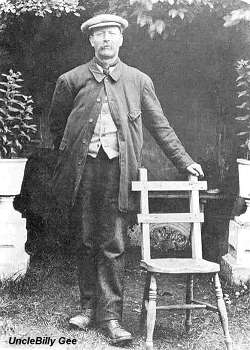 Most of the songs he got from my grandfather. My uncle Tom at Bacton, he knew a lot, but they were different from what Billy's were. Most of them come front the one man; he knew a hundred, my grandfather did, but in them days there was no collecting whatsoever, no tape recorders or anything like that. When he died, he took a lot with him; my uncle sang a lot to me, but he never learned them all. My Uncle at Bacton, he sang different ones … My mother's sister, Ruth, she used to be a fine singer, but my mother's brothers' and sisters' children, they never learned any of the songs; I was the only one who knew any. The last one! But I only sang 'em for myself and for the family, never in pubs …
Now Harry Cox, he used to sing up the Catfield Crown [about 12 miles away], I believe, but I never did meet him. I heard him on the sound radio, and I did see him on television when they gave him a badge or something. I know Sam Larner [maybe 20 miles away] was singing well, too, but I never did meet him either. They were the only two I knew about; I don't think there was a great lot in my time, not in this area. The only old singers I've seen is Percy Webb and Bob Hart - Percy's dead now …
My grandfather got the songs from broadsheets, apparently; that's how they were brought round, so they always told me. He could read music, you see; that was unusual. The reason was, he was born so long ago [surprisingly enough he was born when George IV was king, and he died in 1830]. In his young time, Knapton church had a gallery; the choir sat in the gallery - there was no organ or anything like that - they supplied the music with clarinets and string instruments. He learned to play the clarinet, so you see he could take the music off these broadsheets. As he could read music, he got the tunes, whereas a lot of these poor old men around here - you never had to go very many mile 'til you hear these tunes altered all out of proportion, because they had 'em just by word of mouth, and I think that's why his tunes were so good. The playing, in the churches, that finished very early around here, about 1850 I think, when my grandfather would've been a young man in his twenties. My uncle Billy, he said he remembered when a man-o'-war sunk off Ireland and someone composed a song about it, and two men come along here with one of those broadsheets and sung the song over to my grandfather. I don't know if he bought it, but I was told the words and music was ruled on it, and they charged a penny. That was how they got them into the villages. I asked Uncle Billy how it was that my grandfather managed to learn a hundred, 'cause that was very seldom he went out of the village - perhaps one day in the year to Norwich, or occasionally to North Walsham, and he said that was how they got round: by broadsheets. None of 'em got saved in the family; there was only one old song that I ever did find. The Transports [Van Diemen's Land] - wrote out by hand. I never dial see any of the broadsheets; they must have got destroyed somehow or other. A lot of the things that were my grandfather's have survived in this house though - that chair, and the grandfather clock, and that old Queen Anne table …
I was born in this house, and my mother was too. I haven't been out of the village much myself except during the war, when I got sent all over the country, but I was lucky -- they never sent me out of England 'cause I was working my trade. I was apprenticed in the next village here - Paston. You've heard of the Paston Letters, have you? There's a very famous old barn here, too, a tithe barn - 1581. There's not much to see at Towey's Barn - you ought to look in the church roof here, that better than looking in Towey's Barn.
The church in this village here, it's got the finest roof in the county, double-hammer beam, with about 140 huge angels in, with their wings outspread, all holding something in their hand; one's got a hammer and nippers, and another one is playing an old-fashioned lute, all that sort … That's one thing this village is noted for, and the other is that it was the headquarters of the smugglers hereabouts - that's about the only thing the parish was noted for! My uncle told me that when he was young there was old men around here who knew all about this smuggling; I reckon it must have died out about 1830. Of course they never would own that they'd done any themselves - they was still afraid, you see, even then. I think that was done on a large scale - so was poaching.
My uncle Billy, what had the songs, he was a good man with a gun. His old double-barrelled twelve-bore, that's still here in the shed, and also his equipment for making his own cartridges: powder-flask; shot-flask, wad-cutters, everything what he used to use. He told me years ago they had these muzzle-loaders; he showed me how to set a snare. There was also another instrument here that he used to make bee-skeps with out of brambles. There was a lot of old things here, but my uncle sold them. There was an old wheat-dibbler, shaped like an egg on the bottom, they used to push it in the ground and then drop the wheat in. I've still got a lot of the equipment my mother used to brew beer with - big wooden funnels, and that sort of thing - I've still got the big stone jars she used to put the beer in; some of them came from the brewery at Trunch - they've got primroses on them. The brewing, that was done just before the harvest started. The beer was brewed for the harvest, and a lot of it was drank, too!
Uncle Billy worked on a farm most of the time, and then on the Mundesley golf-links, cutting greens, that sort of thing. His hands were drawn down with rheumatism so he could only move a thumb and finger on each hand. He was taken away from school, you see, and sent to work on the farm when he was seven or eight year old, and his hands used to get so wet. He reckoned that's what caused it; at one time he used to play the fiddle, but by the time I was born his hands got locked like that, and he couldn't move his fingers about on the strings. But he was a very fine singer; had a powerful tenor voice, far away in front of anyone else whatever he sung. No-one approached him. He used to do a lot of singing in the pubs in his young-time - I don't know where he got Old Brown's Daughter from; he most probably learned that in a pub in North Walsham called the Mitre Tavern - that's been finished with long ago … They had a singing room in there - like we have folk clubs now, isn't it? He said they'd sing songs and go round with a hat, collecting in it.
My favourite of the songs is The Rambling Blade. I've heard other versions of it on the wireless, but I like this one the best. I learnt that song sitting on my uncle's knee - that's the truth. That's how I used to learn 'em. He used to lift me up, and I'd sit looking up at him while he sung. He used to sing Caroline a bit, and Bonny Bunch of Roses, and You Generals All ('Marlborough', as you call it). The Transports he never did sing much - that took too long, I suppose! Cock-a-Doodle-doo he didn't sing at all, that came from my uncle at Bacton - that's the sort of song he used to like, and The Cobbler - a bit ribald, you know!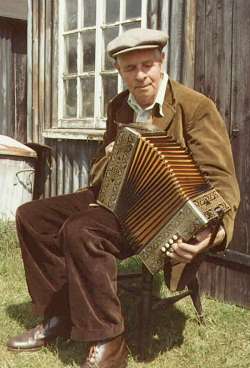
I used to play fiddle, years ago, but that was only amateur playing, all on top of the strings. Do you get a professional, he'd draw his hand right down to the bridge, but I could only play up there. I always liked the accordions the best.
This accordion - I bought it in Norwich ten year ago this summer; sixteen pound, ten. My uncle Walter, he paid ten shilling for his, and that's just about equal in value, 'cause that's what his week's wages were. I still play that, have done for years, in here alone on a Saturday night, never missed. I sometimes sit on the stairs and play, so people can't hear me. I never bring it out. I've never considered myself good enough to bring it out.
My Uncle Walter always had one. My Aunt Alice bought me one for about sixpence with-four keys which would just play a tune, a chromatic you see, it would play eight notes [Walter has the terms reversed - he's actually talking about a diatonic instrument]. I learned to play on that and I had one ever since, different ones, some with ten keys, some double-rowed. I did manage to get a few songs on a piano accordion that I bought about 40 years ago. The push-in note and the pull-out note is just the same. 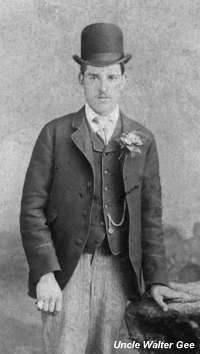 If you've got 21 keys on a piano accordion it's just 21 notes. A chromatic; 21 keys you've got 42 notes, so they don't work the same.
I don't know if anyone can teach you, can they, to play? I suppose he [Uncle Walter Gee] might have had a hand in it. I don't know. Our styles were different. I can play fairly well, I suppose, but in no comparison to what I've heard - Tony Hall, Chris Morley and all them, or anybody else. So that's why I don't bring it out. I don't even compare it to what Oscar Woods can do or Percy Brown, not as good as that, so you know why I just play it for my own amusement.
I never did sing a lot of the old folk songs, not then - not with the older ones alive. That was their perk. They always sung their own songs, you see. Uncle Bob Gee would sing Jones's Ale, that was his song. Tom Gee always sung The Bonny Bunch of Roses - no one else would sing that or dare. They had special songs they sung. The brothers would never sing what another brother sung, nor did they like anyone else to. So I had to sing what no one else wanted to. The Dark-Eyed Sailor, I was allowed to sing that - no one else wanted to and I always liked the song so that went all right with me. When the Fields are White with Daisies, that sort of thing - The Old Rustic Bridge by the Mill, In the Shade of the Old Apple Tree - they were more modern songs what they never bothered much about.
Well, Billy - there's a lot what he taught me that he never did sing much. There were so many repeats, Generals All, Rambling Blade, Young Sailor, Old Brown's Daughter - that was nearly always sung. Part of The Bush of Australia was considered obscene so that was cut out, a lot of that, never did sing all of that through, but that was then. 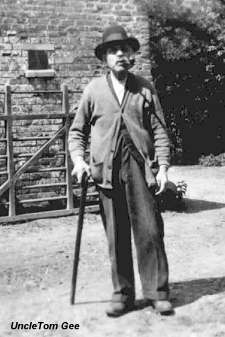 Tom's song, he used to sing The Cobbler mostly … another bawdy old song, Cock-a-Doodle-do. Another one was I Wish They'd Do it Now, that was another one. The Dandy Man, Jolly Wagoners. Tom would sing [The Bush of Australia] through but Billy never would, so there was only a fragment going. He'd tell me the words and I used to write them down because he'd tell me it won't be whole sung through in company. He told me that used to be stopped in public houses, some of the landlords would ban that - that was a banned song. Balderdash, they called that. I don't suppose they'd take much notice now.
He never sung them all [the way through]. He must've known them - he could sing them all [but] I've heard him sing fragments. It was no trouble to learn a tune 'cos the mother, the two lads, they knew the tunes as well as he did. So sometimes I'd nearly got the tune off before I knew the words, he'd supply the words. It was from him and the grandfather that the tunes were got. I never did hear him sing, not a great many, not through. Not as many as he let me have anyhow.
You never did hear him sing Van Diemen's Land right through, but it was only through him I knew it, though. My Aunt Alice would sing a good bit, mother's sister. She's the last one left alive, I lived with her when I had my house altered and modernised a bit. She used to tell me a lot about the songs, the tunes too. She used to enthuse about how well her grandfather used to sing Van Diemen's Land. So did mother and the other sister. They all enthused on how well he sung that. So that was the reason why I liked singing it.
The first time I heard Walter sing - on his Leader LP A Proper Sort - I was immediately struck by how different his melodies for many of the 'standard' songs were. In later years I became familiar with the way some traditional singers decorate, vary and even invent melodies to suit their tastes - Bob Scarce and Cyril Poacher being prime examples - but the underlying 'standard' melody they first learned with the song usually remains intact. But Walter is different - many of his tunes might almost be said to be new ones, loosely based on the originals. Mike Yates has noticed this, too, and says in his notes to A World Without Horses:
"Then there were his tunes. When I first met Walter I was amazed at his large repertoire of songs with their wonderful texts, so much so that I possibly failed to realise not only how important the tunes were, but also how much Walter had consciously, or unconsciously, altered them to his own liking. Walter had a number of well-known songs in his repertoire, songs which different singers usually sing to the same tunes. In Walter's case these included songs such as The Dark-Eyed Sailor, The Bold Fisherman or The Trees They Do Grow High, and it is only now, listening to Walter's recordings, that I have become aware of certain repeated musical phrases which seem to occur only from Walter's lips. It may be, of course, that this is how Walter learnt the tunes in the first place. But somehow I don't think this to be the case. What we are hearing, I feel, are deliberate, subtle variations from a singer who was fully in control of his material and of his performance."
We can't have been the only ones to notice - but no-one seems to have plucked up enough courage to ask him about it in his lifetime, so were are left with conjecture. Certainly, Walter's statements indicate that he had to learn the tunes correctly from his uncles: "… that was no problem to get the tunes though - they got them all correct. They'd know if I never got them right. They had me singing them - they soon checked, you know, telling me if I'd got them right or wrong."
So - was this the way Billy Gee sang them? Do they sound as if they'd been changed that way by a man with "a powerful tenor voice, far away in front of anyone else whatever he sung. No-one approached him! He used to do a lot of singing in the pubs in his young-time"? Or do they sound like the songs of a quiet, thoughtful, sensitive man, who never sang in a pub bar in his life?
We know that in the 20 years from the last Family Christmas party and Walter's making the 'demo tape' for Roger Dixon, he probably never sang the songs at all - but that he did regularly play them on his melodeon. As a melodeon player, I know full-well how tunes can get altered on that simple instrument, almost without your realising it. We also know that it took him all winter to get that tape together, and that he made several attempts at it. "… that sounded so horrible, I wiped them all out." I'm pretty sure that Walter, possibly quite unconsciously, forged his variations on the old tunes in the process of two decades of melodeon playing and getting the songs back into singable form for his final version of the demo tape.
It was shortly after Peter Bellamy met Walter, that Peter approached two record companies on Walter's behalf. It was decided that Leader Records and Topic Records, the two leading folkmusic labels at the time, should send Walter samples of their recent releases so that Walter might choose which company should begin to record his songs. Topic had very little to offer at the time. In the end they sent Walter a copy of their Bob Hart album, which had a very poorly designed sleeve. Leader Records had been formed by Bill Leader, a former employee of Topic, who had moved away to start his own label. Bill had issued a number of fine albums of traditional music, which often featured gatefold sleeves with extensive notes and documentation, and so it was little wonder that Walter chose Bill to record his first two albums.
The first album - titled A Proper Sort (Leader LED2063) - was recorded at Walter's home by Bill, Reg Hall and Peter Bellamy and contained eleven songs, all of which could be classified as 'folk songs'. The song had been chosen by Walter. For the second album, Our Side of the Baulk (Leader LED2111) we find seven or eight 'folksongs', as well as three Victorian tearjerkers, Balaclava, Grace Darling and I'll Hang My Harp on a Willow Tree, all of which I heard Walter sing in public. On one occasion I was sitting next to A L Lloyd when Walter sang Balaclava. 'Why is it,' Bert whispered, 'that singers like Walter love to sing such appalling songs?' And therein, of course, lies one of the great problems for folklorists. How do we reconcile our own likes and dislikes with those of singers from a different background and upbringing? Cecil Sharp and many of his contemporaries avoided the problem by only noting down those songs which fell within their own tight definition of the term 'folksong'. Many later collectors have taken a far broader approach in their collecting. Interestingly, according to Jim Carroll and Pat Mackenzie, Walter prefered to sing 'folksongs' and was well aware of the distinctions between then and the other types of song he sang.
I first met Walter in the Spring of 1978. We had both been invited to a Folk Festival, and I think that I only accepted the invitation knowing that Walter would be there. Like Walter, I am an early riser and I first saw him at eight o'clock one morning, when we were both walking around the campus grounds where the Festival was being held. Having introduced myself, I was slightly taken aback when Walter said that two or three people had already mentioned my name to him and mat he had been looking forward to meeting me. I told Walter that one of my great-grandfathers had left Norfolk to seek work in Lancashire and that, to my shame, I had never actually visited Norfolk myself. We talked about his songs and about Uncle Billy, who taught Walter so many of them, and of Walter's trip to Washington. In fact, we seemed to talk for most of that morning, the only interruption being when he was asked to sing for half an hour. I will never forget the first song that I heard, Jack Hall, and I became determined that I too would record Walter and that Jack Hall would be one of the songs that I would issue on an album.
Walter invited me to visit him in June, 1978, and I began to try to record as many of his songs as possible. 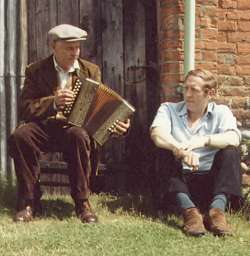 Sometime before meeting Walter, Bill Leader had taken time out to teach me the rudiments of sound recording. One of the things discussed, I remember, was the placement of microphones. When I first recorded Walter I spent some time moving my microphones around his living room in order to find where the acoustics were at their best. When I eventually settled I was pleased to be told by Walter that I had chosen the same place where Bill had placed his microphones!
We would usually spend each morning talking about songs, seeing just what Walter knew and what we could later record. The recordings were made in the afternoon or at night. One morning I mentioned the song Thorneymoor Woods that Harry Cox used to sing. Walter said that he had heard the piece, but that he did not know it. I left him for an hour or two over the lunch period and when I returned it was to find him surrounded by pieces of paper, each sheet bearing a verse to the song. During that short period of time he had managed to remember the whole of what was quite a long song.
One pleasant surprise was to discover that Walter knew a number of songs that dated back to the formation of the early Agricultural Workers' Union. An Old Man's Advice, Hold the Fort and Sons of Labour were complete songs that had once been sung by Uncle Billy. Walter also knew a number of song fragments that seemed to be written from the workers' point of view, such as Slave Driving Farmers that had been sung by Uncle Tom:
They would drive over poor folks
Who stand in the way.
You slave driving farmers,
You pot-bellied farmers,
You're forced to give way
To the labouring men.
Another fragment came from Billy:
Soon the ships will be coming in,
Laden with foreign corn.
We'll make those farmers rue the day
That ever they were born.
Billy also had a verse that parodied the well-known song, The Farmer's Boy:
I'll have no Union rascal mind,
I've just sent them adrift.
And if the Union you're in league,
I'll send you off as swift.
If you will work, do as you're told,
Nor use your tongue awry
You can plough and sow and reap and mow
And be a farmer's boy, and be a farmer's boy,
According to Walter, the Farmer's Boy parody dated from the time of a labourer's strike held at White House Farm, Knapton, in 1910. Uncle Billy said that in the 19th century White House Farm was owned by two brothers, John and Tim Blanchflower, and that John Blanchflower was popular and well-liked by his workers. Following John's death, Tim took over as owner and soon became unpopular, principally because of his insistence that his men 'make their obeisance' by touching their forelocks in his presence. One morning the following verse was found chalked on the front door of the farm:
Your brother John was like a lamb,
And you are like a lion.
Your men must work two days in one,
As if they're made of iron.
Conditions must indeed have been hard, as another fragment, this time from Walter's mother, attests:
Fare you well, old boys, for really I must go.
Work it is so scarce and the wages are so low.
I'll cross the briny ocean, let it hail, rain, blow or snow.
I'm bound to emigrate to New Zealand.
I spent a total of two years visiting and recording Walter. In 1982 Topic Records issued fourteen of these recordings on their album A Country Life (Topic 12TS392) and the following year I issued a further fourteen pieces on my own label, Home-Made Music. (Home-Made Music LP301).
Walter had also been visited by Jim Carroll and Pat MacKenzie who continued to record him when I was unable to do so and, on one occasion, Walter was recorded singing at the Torquay folksong club by Sam Richards (released on People's Stage Tapes 11, Up to the Rigs).
As a result of all this work we now know the titles to 182 songs that Walter knew. A small proportion of these songs were only known as fragments, usually of one or two stanzas, but the majority were known to him as complete songs, about 70 of which would probably have been considered to be 'folksongs' by Cecil Sharp. Of the remaining hundred or so songs, most were either parlour ballads or else were from the late Victorian Music Hall.
The Knapton Drum and Fife Band: A Reminiscence by Walter Pardon
(Walter wrote the following account after he and Mike Yates had spent an evening together talking about past events in Knapton. In common with other East Anglian musicians, he uses the term 'accordeon' to describe the melodeon. Walter can be heard playing one of the band's tunes on these CDs. Mike titled it Uncle Walter's March on the LP, but it may, in fact, be The Grand March that Walter mentions here.)
During the late 1800s the Rolf family came to Knapton and took over the village grocer's store, which is still in existence. They came, as far as I know, from south Norfolk. Jack Rolf, one of the grocer's sons, was a musician and a very fine flute player. He slowly got to know some of the young men in Knapton and found out that some played musical instruments. Jack had the idea that they should form a village band. There were no other bands in the villages around here, so the idea was very welcome especially as all the members were well known. The band was eventually formed with Jack Rolf as the bandmaster and flute player. They also had Albert Sexton (flute), Horace Watts (flute), Billy Mace (flute) Billy Gee (fiddle), Charlie Stewart (fiddle), Walter Gee (accordeon), Ben Mace (big drum), Billy Sexton (3/4 drum) and Nelson Rolf (kettle drum). There were others, but I can't recall their names.
A brick and tiled shed in the yard behind the grocer's shop was known and used as the Band House. It joined the wall of the house that my grandfather John Pardon and my grandmother lived in. As the band practised sometimes until eleven at night, my grandmother used to complain about the noise of the big drum banging and keeping her awake!
Marching tunes and song tunes were played. Some of the tunes were Boys of The Old Brigade, The Grand March, Under The Double Eagle, Yankee Doodle, Hearts of Oak, Tramp The Boys Are Marching and The Thunderer. A board was hung up in the Band House and Jack Rolf would write down the music. He tried to explain to the rest of his band what it was all about, but none had much idea. The only way was to listen to Jack play the tune over several times and learn from him the timing and the tune. One tune, The Grand March, was played when they assembled outside the Band House and as they marched up the village street. At times they played fairly well. Sometimes their playing would break down. This mostly happened if half the band got drunk in a pub before they started to perform.
On Sundays in the summer they played on the concrete, a wide area that led down to Mundesley beach. The older people used to say it was a good band to listen to. No-one minded a few breakdowns and they would shout out for them to try another tune when this happened. One Bank Holiday half the band was drunk before they arrived at Mundesley. A big crowd had gathered round when a quarrel broke out between Ben Mace, who was in charge of the big drum, and one of the other bandsmen. Ben struck the other with the drumstick and broke it. After a few attempts to play they broke down and made for home. Ben was tired of the big drum, and when they got to the top of Larter's Hill he just let the drum roll to the bottom on its own!
At Christmas the band would play carols at the big houses in Knapton, Paston and Mundesley. They were always given money for this. One farmer at Paston would send a message to Jack Rolf to be sure to bring the band at Christmas. He always referred to them as "My Whistles". His Whistles were always given food, beer and money. One year they had enough money to have a dinner as well as beer. One Christmas, Tom Gee, who as far as I know was never in the band, insisted on coming. He brought an old accordeon with no reeds in. He stood near to Walter when they were playing and kept time by pulling and pushing the bellows at the same time. They played at a big house at Mundesley. They were given money from the gentleman who owned the house and when they had finished playing he said, "I have heard accordeons played, but never had I heard two accordeons keep time so well. They sounded like one." In fact they were but one, if he did but know.
After a while a shed was put up on an allotment for the band to play in. This was because the people in the nearby houses had complained about the late-night noises.
The bandsmen all had little round hats with 'Knapton Drum and Fife Band' on in gold letters. The hats were red, though I never saw any of them. Jack Rolf would want to club for paraffin oil in the winter for the lamp. Someone would say, "We'll have neck-oil. Never mind the lamp." A lot of neck-oil was put down at practices. All the bandsmen stood in a semicircle when playing. All watched Jack and when the tune was played for the last time he always moved his left foot forward. One night the noise was so loud that my uncle Bob Pardon flung some stones on the Band House roof to shut them up. Billy Sexton came out and roared like a lion. Made more noise than the band. Once they played on a wagon. That was for the celebrations for King Edward VII in 1902.
How much longer the band lasted I do not know. I don't think there is anyone alive who can remember it. In time men moved from the village. Some got tired of playing and the band finished. The Rolf family gave up the shop and moved to Norwich. Jack Rolf gave Walter and Billy the big drum and the 3/4 drum. The 3/4 drum I have seen. It was sold to the Salvation Army. I still have the old big drum and broken drumstick hanging in my garden shed. All this was told to me by Uncle Walter.
Personality:
It is never easy to really know someone well, especially someone like Walter. I say this, not because Walter deliberately hid things from people, but rather because of the way that we tended to view him.
By the time I first met Walter I was aware of his major status as a singer. He had already recorded two albums and he was being compared to many of the greatest folksingers of previous generations. Within a very short time he had almost become a legendary name. He was 'England's finest folksinger', 'The last great traditional singer' and 'The best of the bunch'.
We first met, early one morning, it was with some trepidation that I went up to him to introduce myself. My first surprise was to be told by Walter that he knew who I was, that people had already mentioned my name to him in connection with the study of folkmusic and folksongs. Secondly, I was surprised that Walter was quite small in stature. Listening to his voice on his Leader albums I had somehow imagined a much larger man. And, thirdly, I was surprised how modest Walter seemed to be. If this was 'England's finest folksinger' then he was handling his new-found fame with remarkable ease. I remember asking Walter about some of the songs that he knew and was promptly invited back to his room where he had a listing of them all. Quietly spoken and outwardly rather shy, there was, nevertheless, a gentle sense of pride as he showed me page after page of song titles. It did not take long for us to be swapping tunes and verses and I think that we would have spent the whole morning together had not somebody called to take him to a session elsewhere. Walter was extremely easy to get on with. There were no 'airs or graces', just a man who was at ease with himself and with anyone else, for that matter.
Walter, on his home ground, was just the same. His house was simply furnished, with not too many nick-nacks. Everything was arranged neatly. His radio, his pipe and his kettle were all kept close to his favourite chair. On the wall hung a Victorian print of the young Nelson being dressed by his mother, in readiness for his first commission. There were a few books and magazines and I soon learnt that Walter was a keen reader with a retentive memory. Not that this should have come as a surprise, considering how many songs he knew. He had read all of Thomas Hardy and most, I suspect, of H E Bates. According to Peter Bellamy he did not care too much for Kipling's work and was quite prepared to argue fiercely about the respective merits of any of these writers.
His garden, like his house, was Spartan, but neat and trim. The lawns were well-cut and there were few, if any, flowers, just the occasional honeysuckle and flowering fruit tree. There were a number of sheds in the garden, where Walter kept his tools and other mementoes from his past. The big drum from the Knapton drum and fife band hung from the roof of one shed. In another there was a large jar full of Victorian clay marbles that he had inherited as a child. A broken cricket bat was a reminder of his deep love of cricket.
Walter's life, like his home and garden, was also neat and ordered. Some mornings he would pedal into North Walsham to collect a local paper and a pint of milk. Lunch would be taken with his cousin Hubert's family in a nearby house. The afternoons were for pottering around the house and garden and the evenings were spent either listening to the radio or else reading a book. Once he had been discovered as a singer by the outside world this pattern would be broken by trips to folksong clubs and festivals. He soon limited these occasions to the summer months - he did not like to return to a cold house in winter! It must be said, though, that he did enjoy the attention that he received at festivals and clubs and it was only when his voice began to fade that he stopped singing in public.
Shortly before I met him, Walter had visited America as part of a British folk contingent that was invited to participate in America's bicentennial celebrations. In many ways this was the highlight of his life and Walter was quite happy to relive the experience by telling me stories about the other, American, singers that he had met. He was especially impressed by one singer - 'a real cowboy' - who let him borrow a Stetson to protect his head from the strong sunshine. Interestingly, he was not too impressed with the Appalachian ballad singer Nimrod Workman who liked to 'act out' a ballad on stage. Songs, according to Walter, were for singing - and that was exactly what he did. Eyes half-closed, hands clasped firmly behind his back, he would let the song tell its own story at its own pace. In many ways, Walter was a private singer - he had not performed much in public and had learnt his songs at home, from his mother and from his various uncles. And, of course, each song carried a meaning for Walter and the family. 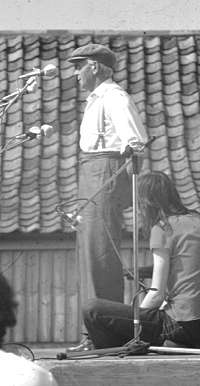 Having sung Two Lovely Black Eyes for me - which tells of a punch-up between a Liberal and a Conservative - Walter shook his head and muttered, "They're still at it today."
I heard Walter sing in many different situations, in his home, in the cosy atmosphere of the Library at Cecil Sharp House, at Folk Festivals and on large concert stages in the presence of hundreds of listeners. According to Martin Carthy, "If you saw him singing in his shirt sleeves you could hardly fail to spot the goose pimples on his arms as he sang." I cannot say that I recall seeing any goose pimples - rather, I remember a man who seemed to treat every situation in the same way. I never noticed any stage fright, but rather felt that Walter approached each performance as a job of work; something to be carried out to the best of his ability. Calm he may have been, but there was also a deep passion lying just below the surface, and this was what made him so good. Walter loved the songs, and he loved to sing them, no matter where.
I recall an interview with Moe Asch of Folkways Records, where he said that no matter how much Ewan MacColl fooled around before making his records, as soon as he started to sing his personality changed and he became thoroughly professional in his attitude. And I feel that it was the same with Walter. There was nothing innate in his singing - Walter knew exactly what he was doing. He knew what constituted good singing and, as a singer, he was working within a set of specific criteria that he had learnt from Uncle Billy and all the other singers. It is sometimes said that folksingers sing 'spontaneously', that they have a natural ability, untarnished by external forces. But this is surely not the case. When Walter was listening to Uncle Billy he was learning not only the words and tunes to his songs, but he was also learning how to sing. At family gatherings Walter soon discovered that certain songs were only suitable for certain types of occasions, and he learnt how singers would vary their songs in regard to different audiences. This is why he was able to sing so well, no matter where he found himself.
Walter was passionate about his music and singing. It should not, however, be forgotten that he had a great sense of humour and that he loved nothing better than to hear a good joke. Once, after singing The Cunning Cobbler, he began to laugh so much that I thought he might be in danger of choking! Walter later told me that he was laughing at a memory of the way his uncle used to sing the song, rather than at the content of the song itself.
Walter could also handle himself well in unexpected situations. I recall John Cohen, a somewhat verbose American folklorist and film maker, becoming extremely excited with Walter's version of the ballad The Broomfield Wager. "Walter," John exclaimed, "I can see it now. You are encapsulated in the world of the ballads!" Walter, who probably had no idea what John was talking about, made no reply, but began to light his pipe. Then, glancing at me, he slowly said, "Well John, I dare say that you're right." On another occasion, when Walter had stopped to talk to a neighbour, John pulled out a Leica camera and began almost pushing it into Walter's face as he clicked away taking any number of photographs. I suspect that Walter was a little taken aback by this, but, typically, he said nothing at the time. Instead he simply took out his pipe, lit up, and let the smoke drift about his head until John was unable to take any more pictures.
There was a sense of spontaneity in many of Walter's actions. Once, after recording a song about a shipwreck, Walter began to tell me of the carvings in Knapton Church which, according to local tradition, had been salvaged from a ship that had sunk close to a nearby beach. 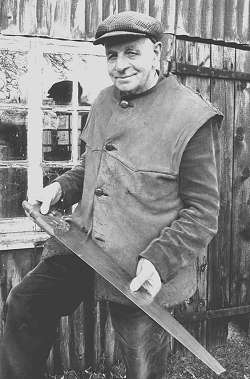 Within minutes of telling me the story we were out of the house and heading down the road so that he could show me the carvings. I am certain that Walter, who had been a carpenter for all his working life, took a delight in seeing a continuity between the church carvings - and the magnificent double hammer-beam roof, for that matter - and his own working experiences. Walter had learnt a trade, of which he was proud, and it was typical that he should wish others to share in that sense of pride. On another occasion, when we were driving along a country road a few miles from Knapton, Walter pointed out another church where some of his own work could be seen. Again, it was typical that Walter should only have mentioned this as an afterthought.
It came as something of a surprise to be told that Walter wanted to be buried in Swafield Churchyard, rather than in Knapton. I mentioned this to a number of his friends and, eventually, was told the following story. It seems that when Walter was a young man he fell in love with a local girl who apparently did not reciprocate his feelings (his song Alice Grey - CD 2, track 9, echoes this situation exactly). I cannot say if she was later married to somebody else or not, but, when she died she was buried in Swafield and it was Walter's wish that if they could not be united in life, then they would be together in death.
I may be wrong, but over the years did Walter think, consciously or unconsciously, about the ballads of Barbara Allen or Lord Lovel when he asked to be buried close to someone he had loved for more than half a century?
And from her grave there grew a red rose,
And from his a briar.
They grew and they grew into a true-lover's knot,
For all true-lovers to admire.
So often we think of folksongs and ballads as being something separate from the people who sing them, (or at least used to sing them), but I think that we are often wrong in this perception. Walter may not have known Barbara Allen or Lord Lovel personally, but I am sure that he believed them to have been real people, possibly as real as were his rural neighbours. I once asked the Virginia singer Dan Tate what he liked about the ballad Barbara Allen and he replied that, 'those last verses just can't be beat'. Scholars may describe the rose and briar motif in terms of poetry, and beautiful poetry at that, but to Dan and Walter, and all those other countless generations of singers, it was always more than that. It was an expression of how their world could be - and, indeed, how it should be.
During his life Walter gave us so much. For the reasons that I have explained above, I think that he also taught us something in his final passing. 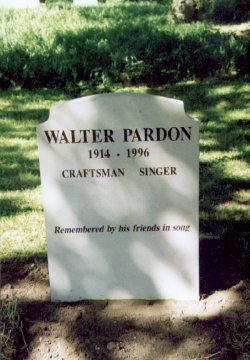 I once said elsewhere that, so far as Walter was concerned, things were never quite as simple as they appeared. It now seems that, even in death, he was able to confirm that statement.
When Walter Pardon died in 1996, his grave was without a memorial stone. On Sunday 5th April 1997, a Celebratory Memorial Concert was held at Conway Hall, London, to raise funds to contribute towards to cost of a headstone. Within a few months, this much-loved man had a fitting and permanent memorial in the Swafield churchyard. The inscription reads:
Walter Pardon
1914 - 1996
Craftsman Singer
Remembered by his friends in song.
[Track List] [Introduction] [Walter Pardon] [In his own words] [Song tunes] [Recorded legacy][Knapton Drum & Fife Band] [Personality] [The Songs] [Discography] [Repertoire] [78rpm Listing] [Credits]
Walter said that he'd learned particular songs from various family members - but accounts differ dependent upon who he was talking to and when. Given the extended period between the family singing and the encounters with the collectors, this is hardly surprising.
Roud Numbers quoted are from the databases, The Folk Song Index and The Broadside Index, continually updated, compiled by Steve Roud. Currently containing over 200,000 records between them, they are described by him as "extensive, but not yet exhaustive". Copies are held at The Vaughan Williams Memorial Library, London, Taisce Ceoil Dúchais Éireann, Dublin, and the School of Scottish Studies, Edinburgh. They can also be purchased direct from Steve at Southwood, Maresfield Court, High Street, Maresfield, East Sussex, TN22 2EH, UK.
Child Numbers, where quoted, refer to entries in The English and Scottish Popular Ballads by Francis James Child, 1882-98. Laws Numbers, where quoted, refer to entries in American Balladry from British Broadsides by G Malcolm Laws Jr, 1957.
CD One - MT CD 305:
1 Cupid the Ploughboy (Roud 986, Laws O7)
As I walked out one May morning,
When may was all in bloom,
I walked into some meadows gay
To take the sweet perfume.
I walked into some flowery fields,
I turned my head awry,
There I saw Cupid the ploughboy,
There I saw Cupid the ploughboy,
That did my heart beguile.
As Cupid was a ploughing
Those furrows deep and low,
Breaking those clods to pieces,
Some barley for to sow.
And as he was a-ploughing,
These words I heard him say:
"No life is like a ploughboy,
No life is like a ploughboy,
In the pleasant month of May."
A worthy rich young gentleman
A-courting to me came.
Because I would not marry him
My parents did me blame.
Adieu young man for ever,
And for ever adieu.
It's Cupid the pretty ploughboy,
It's Cupid the pretty ploughboy,
Who has caused my heart to rue.
Should I write him a letter,
My tale to him unfold?
Perhaps he will take it scornful
And think it is full bold.
I wish he would take it kindly
And return my heart again,
It's Cupid the pretty ploughboy,
It's Cupid the pretty ploughboy,
With his arrows sharp and keen.
The ploughboy heard this lady
In sorrow and complain,
Said he, "My darling jewel,
I'll ease you of your pain.
If you would wed a ploughboy,
Forever I'll prove true.
For you my heart has wounded,
For you my heart has wounded,
And I'll have none but you."
The lady very soon gave consent
To be his lawful bride.
They went into the village church
And there the knot was tied.
And now they live in plenty,
They have got gold in store.
The ploughboy and his lady,
The ploughboy and his lady,
Each other do adore.
Although Steve Roud lists 25 instances of this song in his Folk Songs Index database, he only notes two sound recordings - the other being from Charlie Carver of Tostock in Suffolk. It appears to be virtually unknown outside England. It's older than many songs of this sort, as it appears in Timothy O'Connor's MS songbook, which was complied in 1777/'79. It was first published in Carey, Sailor's Songbag, pp. 40-41.
2 A Country Life (Eggs for Breakfast) (Roud 1752)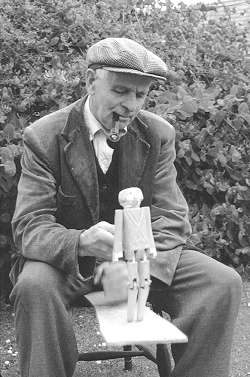
I love to roam through the bright, green fields
I love to live on the farm
I love to take a stroll where the primroses grow
For the country life's a charm
I love to wander through the old farmyard
Round by the old hay stacks
And listen to the cackle of the chickens and the chucks
While the pretty little ducks quack quack.
Chorus:
"Quack, quack, quack" go the pretty little ducks
The hens' "Chuck, chuck" give you warning
When the old cock crows, then everybody knows
There's eggs for your breakfast in the morning.
I love to gaze on the ripe, yellow corn
I love to roll on the grass
I love to take a ramble through the new mown hay
With a pretty little country lass
I love to wander by the old mill-stream
And catch every breeze that blows
And see the lambs as they gambol in the fields
In the morning when the old cock crows.
I love to live on the little white farm
With ivy twined round the door
I love to hear the lark when it soars on high
And listen to the old bull's roar
I like to hear the milkmaid's song
The humming of the busy little bee
You can have your cities, you can have your towns
But a country life for me.
Another song unique to Walter's repertoire, in this instance written by Harry Linn in the 1870s.
3 The Poor Smuggler's Boy (Roud 618)
One cloudy cold morning abroad I did steer
By the wide rolling ocean so deep and so fair
I met a poor boy, who in sorrow did weep
"Alas, my poor father was lost in the deep."
"Mast, sails and rigging, all sunk in the wave
And found, with poor father, a watery grave.
I jumped from the wreck and clasped him to me
But his form it was lifeless - sank into the sea."
"I clung to a plank and swam for the shore
Bad news for poor Mother, dear Father no more.
She died broken-hearted, nor heeded the moan
Of the poor smuggler's boy left to wander alone."
A fine wealthy lady who heard him complain
Took him in for shelter from the cold and the rain
"I will care for this orphan, 'til the day that I die
No more shall he wander with his sad lonely cry."
The lady did die - he the Master became
She left everything in her will to his name
And she kept her promise 'til the day she did die
To care for the orphan with this sad lonely cry.
"Poor Father did venture, all on that salt sea
With a cask of good whiskey to the land of the free.
The lightning did flash and the thunder did roar
Our ship it was wrecked while far off from the shore."
"Oh pity, I crave - won't you give me employ
Alone I must wander" cries the poor smuggler's boy.
A song unknown outside England, it would seem. Roud has 30 references, but only 7 recorded singers, of whom only Angela Brazil was from outside East Anglia. It is also soon to be heard on the forthcoming Smith Family CD from Musical Traditions (MT CD 307), sung by Jabez 'Biggun' Smith in The Fisherman Bar at Beachley Ferry, Gloucestershire, 3 January, 1967, recorded by Peter Shepheard. Biggun called it Our Ship Lost its Rigging.
4 I'm Yorkshire Though in London (Roud 1640)
When first in London I arrived,
On a visit, on a visit.
When first in London I arrived,
Midst heavy rain and thunder.
I spied a bonny lass in green,
The nicest lass I e'er had seen.
I'd oft heard tell of beauty's queen,
Dash me, thinks I, I've found her.
Chorus:
Fol the raddie, fol the raddie,
Right fol the riddle-ol,
Fol the riddle-i-do.
She blushed and smiled, and smiled and blushed,
Else 'twas fancy, else 'twas fancy.
She blushed and smiled, and smiled and blushed,
And I looked very simple.
Her cheeks were like the new-blown rose,
Neglected on the hedge that grows.
Her eyes were black as any sloes,
And near her mouth a dimple.
She stood stock still and so did I,
Gazing on her, gazing on her.
She stood stock still and so did I,
Thinks I, I've made a blunder.
And then her lips turned deadly pale.
I says, "My love what do you ail?"
And then she told a dismal tale,
That she was scared of thunder.
"Madam" says I, and made a bow,
Scraping to her, scraping to her.
"Madam" says I, and made a bow,
"I quite forgot the weather.
If your permission you will give
I'll see you home, where-e'er you live"
And then she took me by the sleeve
And off we went together.
Bonny wild goose chase had we,
In and out so, in and out so.
A bonny wild goose chase had we,
The London stones so galled me.
And then we came up to a door
Where twenty lasses, aye and more,
Came out to have a better glore
At Bumpkin, as they called me.
"Walk in, kind sir" she said to me,
Quite politely, quite politely.
"Walk in, kind sir" she said to me,
Folks said "Poor lad he's undone."
"Walk in" said she. "Not so" said I
"For I've other fish to fry.
"I've seen you home, so now goodbye.
I'm Yorkshire though in London."
My pockets then I rummaged o'er,
Cautious ever, cautious ever.
My pockets then I rummaged o'er,
And found a diamond ring there.
I had this precaution took
And sewed in each a small fish-hook,
And when she groped for pocket book
The barb it stripped her finger.
Three weeks I've been in London Town,
Living idle, living idle.
Three weeks I've been in London Town,
'Tis time to pack for work, sir.
I've sold the ring, I've got the brass,
I have not played the silly ass.
'Tis time to toast the London lass
When I get back to Yorkshire.
The notion behind the song has been popular for quite some time, and numerous songs describing a seemingly innocent countryman abroad in a big city have come and gone over the centuries. Roud has 74 instances of this one, mostly from broadsides, but we only know of its having been collected eight times - four times in Scotland, once in the USA, and from three other singers in England. Sharp got a version from 'Sister Emma' in Clewer, Berkshire, Hammond got a fragment from J Randall in Broadway, Dorset, and Henry Burstow 'collected himself' in his book Reminiscences of Horsham (1911). The first full text was in A Garland of New Songs printed by J Marshall in the Old Flesh Market, Newcastle on Tyne, c. 1810. Almost all the broadsides (and Burstow) called the song Most Politely. Walter's is the only known sound recording from the tradition.
Mike Yates thinks that Walter could only remember the tune plus a few of the words and that he got the bulk of the words from Frank Purslow's book The Wanton Seed. The music hall singer Tom Foy - 'The Yorkshire Lad' - recorded a four-part (two 78 rpm records) The Yorkshire Man in London in 1912. Foy died, aged only 28 years, in 1917.
5 Seventeen Come Sunday (Roud 277, Laws O17)
As I walked out one May morning, one May morning early
'Twas then I spied a pretty maid, so handsome and so clever ...
Chorus:
With my rue-rum-ray, fol-the-riddle-ay
Whack-fol-lura-lido
Her shoes were black, her stockings white and her buckles shone like silver
She had a dark and rolling eye and her hair hung down her shoulders ...
How old are you, my pretty fair maid, how old are you, my honey?
She answered me, quite cheerfully, I am seventeen come Sunday ...
Will you marry me, my pretty fair maid, will you marry me, my honey?
She answered me, quite cheerfully, I dare not for my Mammy ...
If you come down to Mammy's house, when the moon is shining brightly
Then I'll come down and let you in and my Mammy will not hear me ...
Oh Soldier, will you marry me, for now's your time, or never
Oh Soldier, will you marry me, or I'm undone for ever ...
And now she is the soldier's wife and sails across the brine-O
The drum and fife is my delight and a married man is mine-O
A very popular song with 145 instances in Roud from all over the British Isles, USA, Canada and Australia (the wonderful Sally Sloane). It appears with numerous titles, among the most appealing of which is Flash Gals and Airy, Too - used by both Win Ryan and Caroline Hughes. Obviously it has remained a favourite with country singers, and particularly Travellers, into the present era, since there are over 30 sound recordings.
6 The Parson and the Clerk (Roud 1154)
A Parson preached to his flock one day, on the sins of the human race
The Clerk was standing piously, with a solemn look on his face
The Clerk would venture now and then to give a big remark
"Sin is sweet" said the Parson. "Then it's sin for me" said the Clerk ...
"Amen, Amen - Then it's sin for me" said the Clerk "Amen."
"Oh never covet thy neighbour's goods," the Parson said "nor his maid..
To rob a man of what is his, a fellow should then be afraid.
Nor covet ye no man of sin, I venture this better to 'mark
Thy neighbour's wife" said the Parson. "The skivvy for me" said the Clerk ...
Oh never scythe the dross called gold, for blest is the man that is poor
Nor cast you away the loaves of bread, nor the fishes away from the door
I grieve to say that I should drive in a carriage and pair in the park
And a thousand a year" said the Parson. "Oh give it to me" said the Clerk ...
My friends and Christian brethren, forever be humble and meek
And do not strike the sinful man when he smiteth you one on the cheek
But turn my friends, the erring one you stands the sinner so dark
Thy other cheek" said the Parson "I'll land 'im one" said the Clerk ...
"The boys they are so troublesome" the Parson said with a groan
"And often in the Sunday School, they won't leave the young hussies alone.
I've watched them grin behind their books, I've seen them at their larks
They were kissing the girls" said the Parson. "The Maid for me" said the Clerk ...
"And now my sermon's ended, Friends, now all go to work and to pray
Don't always do what your Parson does, but do what your Parson will say.
Before I leave you all, my friends, I'll venture this better to 'mark
Never take strong drink" said the Parson "A gallon for me" said the Clerk ...
Written by Geoffrey Thorn (Charles Townley) and published in 1882, it would seem that this song was not much taken-up by the tradition - the only known instances being Walter and Phil Tanner.
7 Blow the Winds I-O (Roud 1778)
Hey ho for a gay and gallant barque
A brisk and lively breeze
A valiant crew and a Captain, too,
To carry me over the seas
To carry me over the seas, my boys
To my sweetheart, young and gay
She's taken a trip on a sailing ship
Ten thousand miles away
Chorus:
Blow the winds I-O, roving I will go
I'll stay no more on England's shore
So let your music play
I'm off by the morning train
To cross the raging main
I'm on the move to my own true love
Ten thousand miles away.
My sweetheart she is beautiful
My sweetheart she is fair
Her eyes are blue as the violet's hue
And golden is her hair
And golden is her hair, my boys
And while I sing this lay
She doing the grand in a foreign land
Ten thousand miles away.
I wish I were a captain bold,
And then I do declare
I'd hire a boat and away I'd float
To my own true-love so dear
To my own true-love so dear, my boys
Where the fishes lark and play
The whales and sharks are having larks
Ten thousand miles away.
The sun may shine through the thickest fog
The rivers run bright and clear
The ocean's brine be turned to wine
Before I forget my beer
I'll never forget my beer, my boys
While I have means to pay
I'll never part with my own sweetheart
Ten thousand miles away.
More usually known as Ten Thousand Miles Away, it's found - though infrequently - all over the English-speaking world. Stan Hugill has a shanty version of it in Shanties of the Seven Seas, and Louie Hooper and Robert Cinnamond also sang it. Only one other English recording is known, by Fred Smale from Hassocks, Sussex.
8 Hold the Fort (We Meet Today in Freedom's Cause) (Roud 1774)
We meet today in freedom's cause
And raise our voices high.
We join our hands in Union song
To battle or to die.
Chorus:
Hold the fort, we are coming
Union men be strong
Side by side, keep pressing onward
Victory will come.
Look my comrades, see the Union
Banner waving high.
Reinforcements are appearing
Victory is nigh.
See our numbers still increasing
Hear the bugle blow.
By our Union we shall triumph
Over every foe.
Fierce and long the battle rages
But we do not fear.
Help will come whene'er it's needed
Cheer my comrades, cheer.
Virtually nothing is known about this song, and Walter's is the only collected example. He has several other Union songs in either full or fragmentary form, and these and the circumstances surrounding them are discussed in Mike Yates' The Socio-political Songs of Walter Pardon article in these pages - see Articles.
9 All Among the Barley (Roud 1283)
Come out, 'tis now September, the Hunters' moon's begun
And through the wheat and stubble is heard the frequent gun
The leaves are pale and yellow, and kindling into red
And the free and golden barley is hanging down its head
Chorus:
All among the barley, oh who would not be blythe?
When the free and happy barley is smiling on the scythe.
The Spring she is an old maid and does not know her mind
The Summer is a tyrant of most outrageous kind
The Autumn is an old friend and does the best he can
To bring the golden barley to cheer the heart of man.
The wheat is like a rich man, all sleek and well-to-do
The oats are like a pack of girls, laughing and dancing too
The rye is like a miser, all sulky, lean and small
And the free and golden barley is monarch of them all.
This is the only instance, according to Roud, of this song being recorded in the tradition, and he only knows of it being collected once elsewhere - by Alfred Williams from Henry Serman of Stanton Harcourt in Oxfordshire … although Henry Burstow included the title in his repertoire list. The remainder of his 14 instances are all from broadsides or books.
10 Black-eyed Susan (Roud 560, Laws O28)
All in the Downs the fleet lay moored,
The streamers waving in the wind,
When black-eyed Susan came on board;
"Oh, where shall I my true-love find?
Tell me you jovial sailors, tell me true
If my sweet William ...
If my sweet William sails among your crew."
William, who high upon the yard,
Rocked with the billows to and fro,
'Twas then her well-known voice he heard,
Then he sighed and cast his eyes below.
The cord slides swiftly through his glowing hands,
And swift as lightning ... on the deck he stands.
How swift the lark, high poised in air,
Shuts close his pinions to his breast.
By chance his mate's shrill call he hear,
Then he drops at once into her nest.
The noblest captain in the British fleet
Might envy William's ... lips those kisses sweet.
"Oh Susan, Susan, lovely dear,
My vows forever true remain.
Let me kiss off this falling tear,
We only part to meet again.
Love turns aside the cannon balls that fly,
Lest precious tears ... should fall from Susan's eye."
"Heed not the landsmen when they try
To tempt away thy constant mind.
They tell thee, sailors, when away,
In every port a mistress find.
Yes, yes, believe them when they tell thee so,
For thou art present ... whereso'er I go."
"If to fair India's coast we sail,
Thy eyes are like the diamonds bright.
Thy breath is Afric's spicy gale,
Thy skin is ivory so white.
Thus every beauteous objects that I view,
Wakes in my soul ... some charm of lovely Sue."
"Though battle calls me from thy arms,
Let not my pretty Susan mourn.
Though cannons roar, yet safe from harm,
I to my love will safe return.
Love turns aside the cannon balls that fly,
Lest precious tears ... should fall from Susan's eye."
The boatswain gave the dreadful word,
The sails their swelling bosom spread.
No longer must she stay on board,
They kissed, she sighed, he hung his head.
Her less'ning boat unwilling rows to land:
"Adieu", she cries ... and waves her lily hand.
When John Gay wrote Sweet William's Farewell to Black-Eyed Susan (published in 1720), he can little have imagined that it would form part of the oral tradition of a family of Norfolk farm workers two and a half centuries later, let alone that the singing of one of them should be published on CD in the 21st century! But the truth is often stranger than our wildest imaginings. By 1730, Richard Leveridge has set the poem to music and the resultant song became extremely popular for 100 years or more - so much so that a number of sequels sprang up to trade on the original's popularity. Sweet William's Return to his Dear Susan was followed by Sweet Susan's Constancy and The True Answer to Black-Ey'd Susan … there may have been others (vague rumours of Son of Black-Eyed Susan and Black-Eyed Susan Goes Line-Dancing have been heard …) Even a stage play resulted, Black-Eyed Susan or All in the Downs (1829), involving the imagined melodramatic consequences of Sweet William's return.
The song did not survive well into modern times - Roud lists 141 sightings, but almost all are from old broadsides and books. Only seven are collections from the tradition and none are very recent, although Bob Hart of Snape, Suffolk, had it in his repertoire in the 1970s. Walter's is the only known sound recording - reading through these notes you will find that this is very often the case. He sings the song beautifully, clearly relishing its gorgeous soaring tune, and utterly involved in the emotional impact of the final verses.
11 Caroline and Her Young Sailor Bold (Roud 553, Laws N17)
It's of a rich nobleman's daughter,
Uncommonly handsome, we hear
Her father possessed a large fortune
Of thirty-five thousands a year
He had only one daughter
Caroline her name, so we're told
One day, from a drawing-room window,
She admired a young sailor bold.
His cheeks they appeared like the roses,
His hair it was black as jet
Young Caroline watched his departure
Walked round until William she met
She said "I'm a nobleman's daughter,
Possessed of ten thousands in gold
I'll forsake both my father and mother,
To wed with a young sailor bold."
Said William "Young lady, remember,
Your parents you are bound to mind.
On sailors there is no depending,
When their true-love they've left far behind.
Be advised, stay at home with your parents
And do by them as you are told
And never let anyone tempt you,
To wed with a young sailor bold."
She said "There's no one shall persuade me,
One moment to alter my mind
I'll ship and proceed with my true-love,
He never shall leave me behind."
She dressed like a gallant young sailor,
Forsook both her parents and gold.
Four years and a half on the salt sea,
She ploughed with her young sailor bold.
Three times with her love she was shipwrecked
And always proved constant and true.
Her duty she did like a sailor,
Aloft in her jacket so blue.
Her father long wept and lamented,
From his eyes tears in torrents long rolled,
'Til at last they arrived safe in England
Caroline and her young sailor bold.
Then Caroline went to her father,
All dressed in her jacket so blue
He received her and momently fainted
When first she appeared in his view.
She said "Dear father, forgive me,
Deprive me forever of gold.
Grant me my request, I'm contented,
To wed with my young sailor bold."
With all troubles at sea far behind them
And a love that would last throughout life
With fond parents' joy and their blessing
Caroline soon became William's wife
They wedded, and Caroline's fortune
Was five hundred thousands in gold.
And now they live happy together,
Caroline and her young sailor bold.
Roud lists 91 instances of this song, which seems to have been widely popular throughout these islands (17 collected examples in England, 6 in Ireland and 7 in Scotland) - though it doesn't seem to have survived well in Scots oral tradition in recent years, since there are no recordings. But there are 14 from England and Ireland - Gordon Hall, Norman House, Tony Harvey, Maggie Murphy and Sarah Makem being among the more well-known singers.
Walter learned the song from his uncle Bob Gee - and Ben Baxter from nearby Southreps also sang it. Joe Heaney will soon be able to be heard singing his version of it on the forthcoming MT production on Topic TSCD518D / CICD143 double CD, The Road From Connemara.
12 Lord Lovel (Roud 48, Child 75)
Lord Lovel stood by his own castle gate
Combing his milk-white steed
When up came Lady Nancy Belle
To bid Lord Lovel Godspeed, Godspeed
To bid Lord Lovel Godspeed.
"Where are you going Lord Lovel?" she said
"Where are you going?" said she
"I'm leaving my Lady Nancy Belle
Strange countries for to see ..."
"How long you'll be gone Lord Lovel?" she says
"How long you'll be gone?" said she
"Year or two, or three at the most
I'll return to my Lady Nancy ..."
He hadn't been gone but a year and a day
Strange countries for to see
When this thought came to his head
He'd return to his Lady Nancy ...
He rode and he rode on his milk-white steed
'Til he came to London Town
And then he heard the church bells all ring
With the people in mourning all round ...
"Ah, who is dead?" Lord Lovel said
"Ah, who is dead?" said he
"Lady is dead", an old woman said
"They call her the Lady Nancy ..."
He ordered her coffin to be opened wide
Her shroud to be turned around
And then he kissed her clay-cold cheeks
While the tears came trickling down ...
Lady Nancy died as it was on today
Lord Lovel died as tomorrow
Lady Nancy died from a broken heart
Lord Lovel died from sorrow ...
They buried lady Nancy in the high chancel
Lord Lovel they buried the lower
And out of her bosom there grew a red rose
And out of Lord Lovel's sweet briar ...
Then out of her bosom there grew a red rose
And out of Lord Lovel's sweet briar
And both of them grew to the top of the church
'Til they could not grow any higher ...
And after they'd grew to the top of the church
'Til they could not grow any higher
They tied themselves into a true-lover's knot
For true lovers all to admire ...
One of the 'big ballads'; Roud lists 230 instances of this song - although there are only 20 sound recordings, and only 4 of these are from England. Child gives nine texts, of which five are Scots and four English. Bronson gives seventy-one versions, sixty-seven of which are recorded in the 20th century from oral sources. Of this number forty-eight are North American, twelve English five Scottish, one Irish and one Manx. The oldest of Clild's texts is from the Percy Papers, c. 1650.
The history of the parodies of this ballad is fascinating. In 1846, the same year as the appearance of the broadside in London, a comic actor in Vauxhall Gardens, jumped into the fray with a normal text with the following insertion:
Then he flung his self down by the side of the corpse,
With a shivering gulp and a guggle,
Gave two hops, three kicks, heaved a sigh, blew his nose,
Sung a song and then died in the struggle - uggle - uggle
Sung a song and then died in the struggle
... and a good many of the later parodies have included this glorious verse. By 1850-55, Gavin Greig notes, Sam Cowell, the English comic-actor, was singing in Aberdeen a parody of the ballad, entitled Joe Muggins. Charlie Hill (of Drewsteignton, Devon) also used to sing a good one.
13 The Skipper and his Boy (Roud 2680)
The sea ran high and the winds waved wild
When the Skipper calls to his only child
"My boy, if fear doth assail thee now
Go pray in silence down below"
"Fear, Fear!" cried the boy "I know no fear
Father, when thy right hand is near
For o'er the green wave 'neath the morning sky
We'll ride together, my father and I
We'll ride together, my father and I"
"And Mother will watch from the door and pray
For us both, dear Father, 'til break of day
She will be the first when her prayer is done
To catch sight of our sail 'neath the morning sun"
"Yes, yes" quoth the Skipper, brief and stern
Tomorrow will see our back return
For o'er the green wave 'neath the morning sky
We'll ride together, my boy and I
We'll ride together, my boy and I"
She's watching, watching, but never more
Will that gallant skipper return to shore
The boy's black handkerchief lies on the sand
It was tied round his neck by her parting hand.
And all that there of the Skipper remains
The compass that he will ne'er use again
For she knows that full well on the jasper sea
They're riding together, the boy and he
They're riding together, the boy and he.
... That's all there is to that one, Mike.
Another song of which little is really known. There are three broadside catalogue references and one in Alfred Williams' MS index. The only other 'real' evidence of it in the tradition is Sharp's 1906 collection of it from Captain Vickery of Minehead, Somerset. Walter's is, again, the only sound recording.
14 Thornaby Woods (Roud 222)
In Thornaby Woods in Nottinghamshire
Whack-folural-I, whack-fol-laddle-dee
In Thornaby Woods in Nottinghamshire
Whack-folural-I-day
Three keepers' houses stood three-square
About a mile from each other they were
Their orders were to look after the deer
Right-fol-the-rol-riddle-al-day
Me and my dogs went out one night
The moon and stars were shining bright
Over hedges and over stiles
With my three dogs all at my heels
To catch a fat buck in the Thornaby fields ...
The very first night I had bad luck
One of my very best dogs got shot
He came to me all bloody and lame
And sorry I was to see the same
For he wouldn't be able to follow his game ...
I looked at his wounds, and I found them slight
'Twas done by a keeper all out of spite
I'll take my pike-staff in my hand
And I'll search the woods 'til I find that man
I'll tan his old hide right well if I can ...
We hired a butcher to kill the game
Likewise another to skin the same
The very first joint we offered for sale
Was to an old woman who sold bad ale
She had us all up into Nottingham gaol ...
Now Nottingham 'sizes are drawing nigh
An' us three chaps have got to be tried
The Gentlemen laughed her all to scorn
That such an old woman should be forsworn
Into little pieces she ought to be torn ...
Now Nottingham assizes are over and past
An' us three chaps are clear at last
Neither bucks nor does will ever go free
For a poachers' life is the life for me
A poacher I will always be ...
A poacher I am and a poacher I'll be
A poachers' life is the life for me
A poacher I will always be ...
Walter's tune for this poaching song is rather unusual, in that it is just the second half of a double-length tune which is usually used for this song - and one is always expecting it to drop down to the root chord for the start of each verse ... and it doesn't!
Although the song appears in 57 entries in Roud, it has only been recorded five times in the tradition - unsurprisingly, two of these are from Travellers. It's also unusual that the song is never found in Ireland, Scotland or Wales - and the same is true of The Oakham Poachers, Hares on the Old Plantation, etc. Somewhat surprised by this, I tried a data search on all those songs with the word 'Poacher' in the title and found 130 instances in Roud's database - only three of which could be identified as not being English! Are we the only thieves in these islands - or just the only ones who enjoy singing about it? It could, of course, be because Ireland and Scotland weren't hammered by Parliamentary enclosure of common lands to anything like the extent that England was, and may also be do with the way in which the English, alone in Europe if not the world, have accorded to landowners rights of ownership over the wild animals which happen to be on their domains at any particular time.
15 An Old Man's Advice (Roud 1482)
My grandfather worked when he was very young
And his parents felt grieved that he should.
To be forced in the fields to scare away the crows
To earn himself a bit of food.
The days they were long and his wages were but small
And to do his best he always tried.
But times are better for us all
Since the old man died.
Chorus:
For the Union is started, unite, unite.
Cheer up faint-hearted, unite, unite.
The work's begun, never to stop again
Since the old man died.
My grandfather said in the noontide of life
Poverty was a grief and a curse.
For it brought to his home sorrow, discord and strife
And kept him poor with empty purse.
So he took a bold stand and joined the Union band
To help his fellow men he tried.
A Union man he vowed he'd stand
'Til the day he died.
My grandfather's dead - as we gathered round his bed
These last words to us he did say:
"Don't let your Union drop, nor the agitation stop
Or else you will soon rue the day.
Get united to a man, for it is your only plan.
Make the Union your care and your pride.
Help on, reform, in every way you can"
Then the old man died.
Walter learned this song from his uncle Billy Gee, and it appears to be unique to the Gee family repertoire - and, since it's a re-working of My Grandfather's Clock as a Union song, it could easily be the product of a local pen. He had several other Union songs in either full or fragmentary form, and the reader is directed to The Socio-political Songs of Walter Pardon in these pages - see Articles for further information on these songs, and the circumstances surrounding them.
16 If I Were a Blackbird (Roud 387)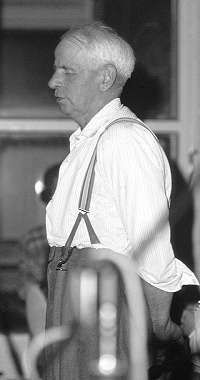
I am but a poor girl, my life it is sad
Many months I've been courting a fine sailor lad
I courted him truly, by night and by day
And now on a transport, he's gone far away
Chorus:
If I were a blackbird, I'd whistle, I'd sing
I'd follow the vessel my true love sailed in
High on the top rigging I'd there build my nest
I'd lay all night long on his lily-white breast.
My love he was handsome in every degree
But my parents despised him because he loved me
And let them despise him and say what they will
Whilst I've breath in my body I'll love my lad still.
He promised to take me to Donnybrook fair
With a bunch of pink ribbon to tie up my hair
And if I could see him, I'd greet him with joy
Upon the fond lips of my young sailor boy.
If I were a scholar and could handle my pen
Such a fond, loving letter to him I would send
I'd tell him my troubles, my joys and my woe
On the wings of a blackbird together we'd go.
Given this song's popularity, it comes as something of a shock to find only 27 examples noted in Roud. Perhaps it's a song of fairly recent composition, and one largely ignored by British collectors of earlier years (although Sharp bucked the trend by collecting it three times!) For some reason it always seems to turn up with exactly the same number of verses - there are never any 'floating' verses attached. Mike and I remember that it was often to be heard on the radio when we were kids (Delia Murphy made a famous recording of it in the '30s, as did Ronnie Ronalde in the '50s) - this may have 'fixed' it in people's memories.
It has been found all over these islands and several other important singers must have valued it enough to learn it - Robert Cinnamond, Jean Ritchie, Belle Stewart, May Bradley ... even Paddy Tunney! Listen to 'Diddy' Cook's version on the Voice of the People and relish that amazing chorus-singing (recorded in Eastbridge Eel's Foot in 1939) - then try to tell me that folk clubs were a sixties invention.
17 Bonny Bunch of Roses-O (Roud 664, Laws J5)
The dangers of the ocean,
One morning in the month of June
The feathery warbling songsters
Their charming notes so sweet did tune
There I espied a female,
Seemingly in grief and woe
Conversing with Young Bonaparte,
Concerning the bonny bunch of roses-O
Then up steps young Napoleon
And takes his mother by the hand
"Oh Mother, pray have patience
Until I'm able to take command.
I'll raise a terrible army
And through tremendous dangers go
In spite of all the universe
I'll gain the bonny ...
"Now son, don't speak so venturesome,
Old England is the heart of oak
England, Ireland and Scotland -
Their unity never has been broke
Now Son, look at your Father
On Saint Helena his body lies low
Soon you may follow after,
So beware of the bonny ..."
"The first time you saw great Bonaparte
You went down on your bended knee
And asked your father's life of him -
Which he did grant most manfully
He said 'I'll take an army
And over the frozen Alps we'll go
Then I will conquer Moscow
And return to the bonny ...'"
He took five hundred thousand men
Likewise kings to join his throng
He was so well provided
Enough to sweep this world along
But when they came near Moscow
They were overtaken by driven snow
All Moscow was a-blazing
So they lost the bonny ...
"Oh Mother, adieu for ever
Now I'm on my dying bed
If I had lived I should a-been clever
But now I must drop my youthful head
And as my bones do moulder
The weeping willow o'er me grow
The deeds of bold Napoleon
Shall sting the bonny ...
Walter learned this from Uncle Tom Gee - another big ballad, though obviously of fairly recent origin, i.e. after 1832, since it concerns Napoleon II, and mentions his death - though it's central character is clearly his father Bonaparte.
Napoleon Bonaparte was unquestionably a hero - or potential liberator - to sections of the English working classes (we may presume that this attitude extended to oppressed classes throughout Europe). This may be attributed to the social and economic conditions of the time; Combination Acts, Transportation, inhuman floggings, the Peterloo massacre … everything in fact that Shelley had in his sights when he wrote The Mask of Anarchy.
The times were extremely oppressive: ideals of freedom and democracy for the lower orders were anathema to the ruling class; and aspirations of liberty and equality had filtered down to the lower orders from a then undemocratised emergent bourgeoisie. Revolutions never happen in vacuums, and the conditions which gave rise to the French and American Revolutions, and indeed the abortive Irish one, were at work all over Europe. Also, the success of the first two was fed into the consciousness of oppressed peoples everywhere. The French Revolution had acted as a beacon to the contemporary English working class in just the same way that the Russian Revolution mobilised left wing labour a century or so later. Thus, Napoleon was viewed as the emblem of liberty and the saviour of the working classes in the same way as Lenin and Stalin eventually were.
It is likely that many Napoleonic songs are Irish in origin, yet it would seem that they had a common currency throughout these islands. For instance, Robert Cinnamond's Napoleon Bonaparte was learnt by him from someone who'd picked it up in England. Henry Burstow’s repertoire included seven Napoleonic songs and Holloway & Black in Later English Broadside Ballads list about a dozen, all from English printers. In this context it’s worth remembering that the working poor of both Ireland and England suffered very similar oppressions, for much the same reasons, from much the same people … and sometimes from exactly the same people! Whatever the case, it's interesting to note that of the literally dozens of Napoleon ballads printed in England at the time (mostly jingoistically opposed to 'The Little Corsican'), almost all those remaining in the country singers' repertoires a century later were either ambivalent or actually pro-Bonaparte.
If Napoleon provided the basis for many broadside ballads, none has survived so well as this supposed conversation between Marie Louise of Austria, Bonaparte's second wife and her son Napoleon II (1811-1832). Following Bonaparte's abdication in 1814, the Allies refused to recognise Napoleon II who was left alone in Vienna. Like his father before him, the young Napoleon's dreams of power were dashed - in his case, by an early death from tuberculosis.
The 'Bonny Bunch of Roses' refers to the Act of Union, passed in 1800 and enacted in 1801, and was seen by the Irish as a reaction to Napoleon's intervention in Ireland on behalf of the United Irishmen. Hence, Irish singers tend to sing 'The deeds of bold Napoleon will enshrine the bonny bunch …' The point being that Napoleon's attempts at liberation ended up having the opposite effect of that which was intended. That point was naturally lost on English singers (like Harry Cox and Phil Tanner) who took the Bonny Bunch to simply mean the three nations, and tended to sing 'sting' instead.
The melody, basically the same as the one Cox, Tanner and Poacher used to sing, derives from the Irish slow air, An Beinsín Luachra (The Little Bunch of Rushes). Curiously enough, the text seems to be derived from an English language translation of this song, a version of which was published by Donal O'Sullivan in Songs of the Irish. A text of The Bonny Bunch of Roses, printed by Haly of Cork and republished in Zimmermann Songs of Irish Rebellion has 'the bonny bunch of loughero' (corruption of luachra - rushes). It also has the opening line 'By the Danube as I wandered' (Danube becomes 'Dangers' perhaps?). The text is undated, but Zimmermann estimates it to be circa 1830. Cyril Poacher sings a splendidly terse version on Plenty of Thyme (MT CD 303). Walter uses an almost identical text, but has included elements of Black-eyed Susan into the first and third lines of his tune.
18 The Green Bushes (Roud 1040 / Laws P2)
As I was a-walking one morning in Spring
To hear the birds whistle and the nightingales sing
I met a young damsel and sweetly sang she
"Down by the green bushes, he thinks to meet me."
I stepped up to her and this I did say
"Why wait you so long, love, on this sunny day?"
"My true-love, my true-love" so sweetly sang she
"Down by the green bushes, he thinks to meet me."
"I'll buy you fine dresses and a new silken gown
I'll buy you a fine petticoat with a flounce to the ground
If you will promise you'll be true to me
And leave the green bushes, and marry to me."
"I want none of your dresses nor your fine silken hose,
I ne'er was so poor as to marry for clothes.
But if you will promise you'll be true to me,
Then I'll leave the green bushes and married we'll be."
"Come let us be going, kind sir, if you please
Come let us be going from beneath these green trees
For my true love is coming and plainly I see
Down by the green bushes, he thinks to meet me."
And when he arrived there and found she had gone
He stood there so lonesome, so sad and forlorn,
"She's gone with another and forsaken me
So adieu to green bushes, for ever" cried he.
Although The Green Bushes was printed widely on broadsides it does not appear to have survived well in tradition - only 14 recorded instances appear in Roud - a surprising fact when one considers its one-time popularity. Instances of the song can be traced back to 1740 via broadsides and MSS.
It was fairly popular in Ireland due, possibly, to a 78 recording. It has been seen published in a 'Sing a Song of Ireland' type book and has been sung at fleadh competitions, where it seems acceptable as an authentic Irish ballad. It appears in Irish Fireside Songs No 8, published by Walton's Musical Instruments - not dated, but probably '40s or '50s to judge from the cover illustration. Roud lists 81 oral sources, of which only four are Irish. He also notes an Australian version from the superb Sally Sloane of New South Wales.
Mike Yates comments that this song (along with Lovely Joan, The Knight and the Shepherd's Daughter, Seventeen Come Sunday, etc) is similar to the old French Pastourelles that date from the Middle Ages. In the Pastourelle a knight meets a shepherdess; the setting is usually Spring time (especially May). He tries to court her and offers her all sorts of presents (see Green Bushes) but she says that she is in love with a local shepherd. Usually that is the end of the affair. She goes off with the shepherd and the knight rides off alone. The themes are certainly mediaeval and some scholars have noted the similarity between them and the Song of Solomon.
19 Polly Vaughan (Roud 166, Laws O36)
Come all you young sportsmen who carry a gun
I'd have you go home by the light of the sun
Young Jimmy was out fowling by the moon
When he shot his own true-love in room of a swan.
Then straight to his Uncle young Jimmy did run
Oh Uncle, dear Uncle, have you heard what I've done
Curse that old gunsmith who made me this gun
For I've shot my own true-love in room of a swan.
Then out come old Uncle with his locks hanging grey
Oh Jimmy boy, Jimmy, don't you run away
Don't you leave the old country 'til the trial comes on
For they never shall hang you for shooting a swan.
Like Seventeen Come Sunday this is another extremely popular song (122 instances) all over the British Isles and USA, with a few versions found in Canada and just Sally Sloane, again, in Australia. Given the supernatural elements in some versions, it could be a very old song indeed, yet it still has enormous appeal, so that there are some 25 sound recordings - most of the English ones being from East Anglia.
20 The Saucy Sailor (Roud 531, Laws K38)
"Come my dearest, come my fairest
And tell unto me
Will you wed a poor sailor lad
Who's just come from the sea?"
"You are ragged, love, you're dirty, love,
And your clothes smell of tar
So be gone, you dirty sailor lad
So be gone you Jack Tar."
"If I'm ragged love, if I'm dirty, love
And my clothes smell of tar,
I've silver in my pocket, love
And I've bright gold in store."
When she heard him thus address her,
Down upon her knees she fell
Saying "Ragged, dirty sailor lad
You I love oh so well."
"Do you think I am foolish?
Do you think I am mad?
That I'd wed a poor country girl
With no fortune to be had?"
"I will set sail in the morning
When the meadows are green
Because you have refused me, love
Not for you the gold ring."
Aside from a handful of examples crossing the pond to North America, all of Roud's 63 instances of this song are English, with the majority of these being from Somerset (23 versions - all collected by Sharp and Karpeles). It does not appear to have survived well into the era of sound recordings for, in addition to Walter, only Emily Bishop (Bromsberrow Heath, Herefordshire) and Johnny Doughty (Brighton, Sussex) have been recorded singing it. Johnny's version is very similar to Walter's and was to be heard on his Topic LP Round Rye Bay for More.
21 Little Ball of Yarn (Roud 1404)
In the merry month of May
When the birds they sing all day
I rose up very early in the morn.
A pretty maid I spied
And she lay there on her side
She was winding up her little ball of yarn.
Chorus:
The blackbird and the thrush
They sang out on every bush
"Keep your hand on your little ball of yarn"
The blackbird and the thrush
They sang out on every bush
"Keep your hand on your little ball of yarn"
As soon as it was o'er
Then the maid pulled down her clothes
And straightway to her mother she did go.
I ran across the green
For fear I should be seen
Winding up her little ball of yarn.
Now all you maidens fair
Take a warning from me here
And never rise too early in the morn
When your front-line starts to swell
You will wish that bloke in hell
Keep your hand on your little ball of yarn.
... All right, Mike - laughs ...
Another song which has remained popular with country singers into the present day, with 15 of the 38 known examples being sound recordings. It was much collected in Missouri/Arkansas area (inevitably - given its subject matter - by Vance Randolph), and a scattering in other parts of the US, Canada and Australia. Travellers seem to particularly like it: Win Ryan sang it in Ireland, Mary Ann Haynes in Sussex, and numerous others across much of southern England. Several Suffolk singers had it in their repertoires, but Walter is the only example from Norfolk. It starts unusually with hints of female masturbation, but gets confused and fragmented as it progresses.
22 The Huntsman (Tally Ho, Hark Away) (Roud 1182)
The sun had just peeped its head o'er the hills
The ploughboys whistling 'cross the fields
The birds they are singing so sweet on each spray
Said the Huntsman to his hounds "Tally-ho, hark away."
Chorus:
Tally-ho, hark away, Tally-ho, hark away
Tally-ho, Tally-ho, Tally-ho, hark away.
Come my brave sportsmen, come, make no delay
Quick, saddle your horses and let's brush away
For the fox is in view and he's kindled with scorn
Come my brave sportsmen, come, join the shrill horn.
He led us a chase for sixteen long miles
Over hedges, over ditches, over gates and over stiles.
The Huntsman came up with his musical horn,
We shall soon overtake him, for his brush drags along.
He led us a chase, six hours in full-cry
Tally-ho, hark away, now, soon he must die.
We will cut off his brush with a hallowing noise
And we'll drink a good success to all fox-hunting boys.
A widespread, if not terribly popular song in England - the eight versions in Roud coming from Cornwall to Lincolnshire. It has the unlikely distinction of not appearing in the Holme Valley Tradition's book of hunting songs! As so often, Walter is the unique East Anglian, and recorded, source.
CD Two - MT CD 306:
1 Put a Bit of Powder on it Father (Roud 10671)
The talk of all the neighbourhood
Is my old Father's phiz
You'd have to travel far away
To find a nose like his
It's one of those nice noses
That bloom but never die
And as he goes to work each day
We gather round and cry ...
"Put a bit of powder on it Father
A little bit of powder, do
Put a bit of powder on it Father
Now let me beg of you
For now the cold's got round it
It's gone red, white and blue
Like a Doctor's lamp in the frost and damp
Just a little bit of powder, do."
Now Father, in a raffle
Won such a lovely duck
He put it in the rabbit's house
'Til Sunday, just for luck
On Sunday, to the baker's
He took that duck with pride
To get it cooked so nice and brown -
"Before you go", we cried ...
"Put a bit of powder on it Father
A little bit of powder, do
Put a bit of powder on it Father
Now let me beg of you
For if the neighbours smell it
They'll want to summons you
Put some eau de Cologne on its old wish-bone
And a little bit of powder, do."
One night in our back garden
I saw father quietly crawl
He gave a sign, Mrs Green
Bobbed up against the wall
Pa kissed her and he pinched her
And murmured "Dearest Lou
My heart is all on fire with love"
And I screamed "If that's true ...
Put a bit of powder on it Father
A little bit of powder, do
Put a bit of powder on it Father
Now let me beg of you
For if your heart's on fire
You're not insured too
Where your heart goes wag, put a piece of wet rag
And a little bit of powder, do."
Now Mother went to Music Hall
And Father stayed indoors
The baby woke when she'd gone
And filled the house with roars
Then on his knee he nursed it
And bath'd it nice, as well
And as he put its nightgown on
We all began to yell ...
Put a bit of powder on it Father
A little bit of powder, do
Put a bit of powder on it Father
Now let me beg of you
For the baby won't stop crying
Oh Daddy, 'til you do
So dab it on nice, on the same place twice
Just a little bit of powder, do."
A popular music hall song from the singing of Billy Williams - 'The man in the velvet suit' - an Australian who came to London in 1901. He was a prolific recording artist who died aged 37 years in 1915. During the period 1908-09, Williams recorded this song on no fewer than five occasions - it was issued, variously, on Aco, Homochord, Edison Bell, Pathe, Diamond, Regal, Pelican and Zonophone and, hence, became very popular.
However, it doesn't seem to have remained in the tradition to any degree. We only know of one other instance - Paul Marsh recorded it from Bob Mills of Winchester, Hants, in 1980 and published it on Let This Room Be Cheerful, Forest Tracks FTC 6025.
2 The Cuckoo (Roud 413)
The cuckoo is a pretty bird, she singeth as she flies
She telleth us good tidings, she telleth us no lies
She sucketh all sweet flowers to keep her throttle clear
And every time she singeth "Cuckoo, cuckoo"
The Summer draweth near.
The cuckoo is a pretty bird, no other is as she
That flits across the meadow, that sings on every tree
A nest she never buildeth, a vagrant she doth roam
Like her, I would be singing "Cuckoo, cuckoo"
I nowhere have a home.
Another very popular song, and one that remained so 'til very recently - 26 of Roud's 148 references are to sound recordings. It is known all over the English speaking world and has perhaps been more widely collected in the USA than in Britain (though one might say England, since only a handful of Scots and Irish - and no Welsh - examples are known). A famous version was recorded by Clarence Ashley for Columbia Records in 1929, shortly before the Wall Street crash, and also by by Kelly Harrell on Victor 40047. Ashley's version appears on Harry Smith's six-CD set An Anthology of American Folk Music (Smithsonian Folkways SFW 40090).
Bob Lewis has a very good version of this, from his mother. It's on his Veteran Tape A Sweet Country Life (VT120). As so often, Walter is the unique East Anglian source, even if it is only two verses.
3 Old Joe the Boat is Going Over (Roud 1777)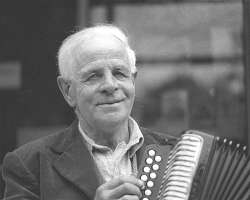
Melodeon tune. Then ...
"Oh, Joe, the boat is going over
Oh, Joe, you naughty man" she cried
"Oh, Joe, I wish you'd been in Dover
Had you ever took me on the water for a ride."
Listeners familiar with East Anglian melodeon playing will be aware that many musicians would normally leave out the pauses (as Walter does here) when playing song tunes like this one. Oscar Woods always used to surprise me with this trait, until I got used to it.
Like I Wish They'd Do it Now, this is a polka tune which became extremely popular among southern English country musicians, particularly in East Anglia, but for which almost no-one seemed to know the words - although they did appear on a Such broadside that Mike Yates once saw.
The only other example of the song (a fuller version) being collected, and recorded in this instance, is from Harry Green of Tilty in Essex, recorded by John Howson, and released on Harry Green (Veteran VT135).
4 Cock-a-Doodle-Do (Roud 3464)
When walking out the other day, along Victoria Park
Along with a very old friend of mine, we went out for a lark
We saw a man a-selling fowls, he had a lovely stock
I gave him a half-a-crown, he handed me a ...
Chorus:
Cock-a-doodle-do, cock-a-doodle-do,
Hickety, pickety, you know what, 'tis quite enough for you
Cock-a-doodle-do, cock-a-doodle-do,
Hickety, pickety, you know what, 'tis quite enough for you.
I put the old cock under my arm, a-walking along the street
Along with a very old friend of mine, my Judy I did meet
She put her arm around me and she gave me quite a shock
She put her hand right up my coat and then she got hold of my ...
I took the old cock home with me, and I put him in a cage
Along with another old hen of mine, and they went in a rage
Some lady friends were passing by and thought it quite a lark
And one of them, she said to me, the hen had got hold of the ...
Kind friends, what I am telling you is only a bit of chaff
The reason why I'm here tonight is just to make you laugh
And when I come this way again, I'll have a better stock
And just to please you, one and all, I'll show you all my ...
The fact that there are only eight Roud entries for this salacious morsel might well indicate that it has been ignored by earlier British collectors, since many country singers, and particularly Travellers, know it - if they can be persuaded to sing it (and if the company is appropriate). It could, of course, be a quite recently-composed song. George Spicer's version is on the Veteran Tapes Ripest Apples (VT107).
5 The Harland Road (Roud 13654) / Wheel Your P'rambulator (Roud 1496) (fragments)
Two fragments of songs that Walter remembered:
Come and see the Kaiser, all on the Harland Road
Come to the back and [?] the place where I abode
You mustn't touch a rabbit, or anything that's there
'Til up to Harland Sitting, you surely will appear.
Lies when you're sleeping, lies when you're dead
Lies all around you, lies on your head
Oh, if you are a liar, you know you're very wrong
For liar is the Kaiser's song.
We have absolutely no idea what this is about at all! There's nowhere called Harland in my AA British Isles Atlas ... I had though that it might be the Norfolk pronunciation of Holland, that being the old name for an area of the county, but this is pure guesswork, and still doesn't make much sense.
The tune is Rosalie the Prairie Flower, which Scan Tester used to play, and Reg Hall later found the song of this name in a broadsheet, and confirms that Scan had it pretty well note for note. Tune and words were by 'GF Wurzel' - George Frederick Root, 1820-1895, Massachusetts. Billy Ballantine also played it, as The Plain Schottische.
Wheel your p'rambulator, Fred, wheel your p'rambulator
Just be careful how you go - wheel it a little bit straighter
That's the way we carry on, when ever we go out
So wheel your p'rambulator, Fred, and mind what you're about.
We don't know if Wheel Your P'rambulator is the same song as The Perambulator Parade that Mark Sheridan recorded in November, 1912 on Jumbo 958. Sheridan was best known for his song I Do Like to Be Beside the Seaside.
Percy Webb of Tunstall, Suffolk, sang (on the Topic LP Flash Company, 12TS243) the only other example of P'rambulator found in Roud of this music hall song - one of many which seem to be unique to East Anglia. The late Al Sealey told me of an informally organised 'pub circuit' of music hall gigs which used to operate in East Anglia right up to the early 1930s, where second-string semi-pro performers would put on shows of their own songs together with the popular hits of the day. This might help to explain the huge number of good, though not widely known, music hall type songs still to be found in the area.
Walter's tune and words are noticeably different from Percy's, though they are clearly both versions of the same song.
6 Ben Bolt (Roud 2653)
Oh, don't you remember sweet Alice, Ben Bolt
With her hair and eyes, eyes hazel brown
How she wept with delight when you gave her a smile
And trembled with fear at your frown?
In the old churchyard in the valley, Ben Bolt
In the corner obscure and alone
They have fitted a slab of granite so grey
And sweet Alice lies under the stone.
Oh, don't you remember the wood, Ben Bolt
Near the green, sunny slope of the hill
How oft we have sung neath its white spreading shade
And kept time to the click of the mill?
The mill has gone to decay, Ben Bolt
Sad silence and gloom reigns round
See the old rustic porch with its roses so sweet
Lies scattered and fallen to the ground.
Oh, don't you remember the school, Ben Bolt
With the master, so kind and so true
And the sweet little nook, by the clear-running brook
Where we gathered wild flowers as they grew?
On the Master's grave grows the grass, Ben Bolt
And the little running brook is dry
And of all our friends who were schoolmates then
There remains none but you, Ben and I.
Roud has 24 sightings of this song, mostly from the USA. It's a composed piece; words by Thomas Dunn English and music by Nelson Kneass. The only other British examples are a 1904 Sharp collection from a Mrs Glover of Huish Episcopi, Somerset, and Henry Burstow's inclusion of its title in the list of his repertoire in his book Reminiscences of Horsham (1911). It's really a rather fine song, both in terms of the sophisticated text and the truly glorious tune which Walter (like Bob Hart) sings with the sort of accuracy which is unusual in a country singer - that last note of the middle eight wouldn't have survived in the mouths of too many pub singers.
7 Uncle Walter's Tune (melodeon)
A nice little three-part polka tune - its first part, at least, is very familiar to a number of friends, but no-one can quite put a name or place to it.
8 Two Lovely Black Eyes (Roud 13631)
Strolling so happy down Bethnal Green
This gay youth you might have seen
Tompkins and I, and his girl between
Oh, what a surprise
I praised the Tories, frank and free -
Tompkins got angry so speedily
And all in a moment he handed me
Two lovely black eyes ...
Chorus:
Two lovely black eyes
Oh, what a surprise
Only for telling a man he was wrong ...
Two lovely black eyes.
Next time I argued, I though it best
To give the Tory side a rest
The merits of Gladstone I freely pressed
Oh, what a surprise
The chap I'd met was a Tory true
Nothing the liberals right could do
And this was my share of that argument, too
Two lovely black eyes ...
The moral you've caught, I can hardly doubt
Never on politics rave and shout
But let the others fight it out
If you would be wise
Better, far better, if you should let
Lib'rals and Tories alone, you bet
Unless you're willing and anxious to get
Two lovely black eyes ...
Written by the Music Hall star Charles Coborn (1852-1945, real name Colin McCallum) who first appeared on the stage in 1879. This song was and first published and sung by him in 1886. In 1890 he followed it up with I'm the Man Who Broke the Bank at Monte Carlo. He continued performing until his death in 1945, aged 93 years. The song also appears in a few very late broadsides. The boxer Freddie Mills had a hit record with it in the '50s, we believe.
Walter has changed the tune and chord pattern of the chorus from the original - very effectively too, I would suggest. Roud's only other traditional source is Michael Leahy of Indian River, Ontario, Canada.
9 Alice Grey (Roud 13755)
She's all my fancy painted her, she is lovely, she's divine
Her heart it is another's, she never can be mine
Yet loved I as man never loved - a love without decay
My heart, my heart is breaking for the love of Alice Grey
My heart, my heart is breaking for the love of Alice Grey.
Her light brown hair is shaded o'er a brow of spotless white
Her dark brown eye now languishes, now flashes with delight
Her hair is braided, not for me, the eye is turned away
My heart, my heart is breaking for the love of Alice Grey
My heart, my heart is breaking for the love of Alice Grey.
I've sunk beneath the summer sun, I have trembled in the blast
The weary pilgrim [?] the early conflict's past
And when the green sod wraps my head, may pity haply say
His heart, his heart was broken for the love of Alice Grey
His heart, his heart was broken for the love of Alice Grey.
Roud has 68 references to this song, but all are of broadside or book sources, so one may assume that it wasn't much taken up by the tradition - though Henry Burstow knew it, of course. Walter's is the only known sound recording.
10 Rosin-a-Beau (Roud 1192)
I've travelled the whole world over,
And now to another I'll go.
For I know that good quarters are waiting,
To welcome poor Rosin-a-Beau
To welcome poor Rosin-a-Beau
To welcome poor Rosin-a-Beau
For I know that good quarters are waiting,
To welcome poor Rosin-a-Beau.
And when I'm laid out on the counter,
A voice will be heard down below.
Crying out for whiskey and water,
To drink to poor Rosin-a-Beau ...
And when I am dead, so I reckon,
The ladies will want to, I know,
To lift the lid of my coffin,
To look at poor Rosin-a-Beau ...
Then get you a dozen stout fellows,
And stand them all in a row.
Give each one a half-gallon bottle,
To drink to poor Rosin-a-Beau ...
Then get half a dozen stout fellows,
And let them all staggering go;
And dig a great hole in the meadow,
And toss in poor Rosin-a-Beau ...
Then get you a couple of tombstones,
Put one at my head and my toe.
And do not fail to write on it,
The name of poor Rosin-a-Beau ...
Come all you old witches and bitches,
Come all you old whores in a row.
And all of you fill up your glasses,
And drink to poor Rosin-a-Beau.
This is the only recorded example of this song from England, according to Roud, although it’s been collected several times. It is, at least recently, very popular in Ireland and we think that the air was also used by Richard Barrett of Bellmullet, Mayo, for a song celebrating the death of the local land agent, one Owen Conway. He called the song Owen Cóir, which means ‘honest’ Owen. However, of the 51 instances in Roud, only the example in Sam Henry’s Songs of the People comes from Ireland - almost all the others are from North America.
Many English country singers learned songs from the Navigators (Navvies) who built the navigations (canals), railways and new roads in the 18th and 19th centuries - and many of these men were Irish. So - while unusual, it's not so surprising to find several Irish songs in Walter's, and many other English singers', repertoires.
11 Not for Joseph, Not for Joe (Roud 13681)
Melodeon tune - then:
Not for Joe, not for Joe
Not for Joseph, not if I know it
No dear no, oh dear no
Not for Joseph, not for Joe
Not for Joseph, described as a 'Galop' on the sheet music, was written and performed by Arthur Lloyd who made his first London appearance in 1862. He was a great favourite at the London Pavilion. Originally from Scotland, he was one of the few singers to be invited to appear in private before the Price of Wales. Towards the end of his life he was known as 'the last of the lions comiques' and died, aged 64, in 1904.
Yet another song found only in broadsides or books, and that rarely - Roud has but eight examples. The tune for Walter's fragment is not quite the same as the polka tune Not for Joe which was fairly popular in southern England.
12 The Old Armchair (Granny's ... ) (Roud 1195)
My Grandmother, she, at the age of eighty three
One day in May was taken ill and died
And after she was dead, the will, of course, was read
By a lawyer, as we all stood by his side
To my brother it was found, she's left a hundred pound
The same unto my sister, I declare
But when it came to me, the lawyer said "I see
She has left to you the old armchair."
Chorus:
And how they chittered and how they chaffed
How my brother and my sister laughed
When they heard the lawyer then declare
Why, Granny's only left you the old armchair.
I thought it hardly fair, still I said I did not care
And in the evening took the chair away
The neighbours they me chaffed, my brother at me laughed
And said "It will be useful, John, some day
When you settle down in life, find some girl to be your wife
You'll find it very handy, I declare
On a cold and frosty night, when the fire is burning bright
You'll be seated in your old armchair."
One night the chair fell down, when I picked it up I found
That the seat had fallen down upon the floor
And there to my surprise, I saw before my eyes
Lot of notes - two thousand pounds, or more
When my brother heard of this, the fellow, I confess
Went nearly mad with rage and tore his hair
But I only laughed at him and I said unto him "Jim
Don't you wish you had the old armchair?"
The original ballad, The Old Arm Chair, was composed in 1840 by Engishman, Henry Russell, with lyrics by Eliza Cook. This was a typical Victorian sentimental ballad:
I love it, I love it and who shall dare
To chide me for loving that old arm chair
I've treasured it long as a holy prize
I've bedewed it with tears, and embalmed it with sighs
Would ye learn the spell, a mother sat there
And sacred a thing is that old arm chair
John Reade parodied this song in the latter part of the century as Grannie's Old Armchair and performed it in Britain and America. The American, Frank Crumit, recorded this parody around 1920 and it was a big seller in Britain. Walter's version is very close to Crumit's apart from the variation in the tune. It does seem extraordinary that this song - which everyone used to know when I were a boy-chap - has only been recorded three times in Britain. In fact there are only six English entries in Roud (none from elsewhere in these islands); the dozen or so others being from the USA and Canada.
Walter's tune is very interesting. It could be that Crumit's tune is a variation on Read's tune and Walter is actually singing the original. The only other person I ever heard who didn't sing the standard version was Jack Smith, a settled Gypsy from Milford, near Guildford, who sang around a few Surrey folk clubs in the 1960s. Jack's verses used something quite near to the 'received' version of the tune, but his chorus was the same as Walter's except for one note. Walter's verse and chorus tunes have a very obvious unity - was this an alternative standard tune which has been lost in the face of recorded versions? Was it something he developed himself? How did Jack have it as well? Was there a pre-existing traditional song which John Reed transformed and made his own? Answers on a postcard, please ...
13 The Marble Arch (Roud 13635)
While strolling by the Marble Arch, one evening in July
A maiden fair, with golden hair, came tripping lightly by
The lustre in her diamond eye shone on me like a torch
And in a whisper softly said "Is this the Marble Arch?"
Chorus:
While around her splendid form, I drew the magic circle
I pressed her, caressed her - my brain was in a whirl
Yet around her splendid form, I drew the magic circle
I kissed her and I called her "A very pretty girl."
I led her to a shady spot, beneath a spreading tree
And taking her by the lily hand, went down upon my knee
"Behold" [I cried her eyes ?] says she, before I'd time to speak
She imprinted one sweet loving kiss upon my blooming cheek.
"Good night" she said so sweetly and gently squeezed my hand
My knees began to knock and shake - I could hardly stand
"We'll meet again tomorrow night" and then prepared to march
"Oh where?" says I, and she replied "Beneath the Marble Arch."
But ever since that very night, I've never seen my Queen
But I've heard say she's run away with a great, fat Horse Marine
A ring I'll give her when we meet, but not as you suppose
I'll never put it on her hand, but stick it through her nose.
Two broadside printers' catalogues and three songsters are the total of Roud's entries for this song, so this may be the only known instance of its having entered the tradition.
Mike Yates has a photocopy of a Victorian Broadside of this song; no printer's imprint (though it is numbered 739) and he would date it at about 1880. According to the broadside, it was written, composed and sung by one Sam Bagnall.
14 Wake Up Johnny (Roud 13646) / When the Cock Begins to Crow (Roud 12895) / Saving Them All for Mary (Roud 15130) / Down by the Old Abbey Ruins (Roud 13629) (fragments)
Wake up Johnny, wake up John
Wake up Johnny, put your trousers on
The clock strikes six, the morning is fine
This week we want to have a bit of overtime.
Jump out of bed, jump out, my boys
Lying long looks lazy
Let the morn be wet or dry
If it should be hazy
Light or dark, get up with the lark
Don't care for frost nor snow
Jump out of bed, jump out, my boys
When the cocks begin to crow.
I'm saving them all for Mary
She shall have every one
I'm saving them all for Mary
Won't there be lots of fun
And when we're together, how happy we'll be
With kisses sweet, my true-love I'll greet
Under the old oak tree.
Where no eye could see, no tongue could tell
The birds only knew of our doings
I quickly embraced my love round the waist
Down by the old abbey ruins.
A collection of fragments that Walter remembered. I can tell you nothing about any of them except that most of their titles all appear in a few books and broadsides listings. Saving Them All for Mary is listed by both Such (London) and Sanderson (Edinburgh) in their catalogues, and When the Cock Begins to Crow is in Pearson and Sanderson - so at least these two are probably of late 19th century composition.
15 The Mistletoe Bough (Roud 2336)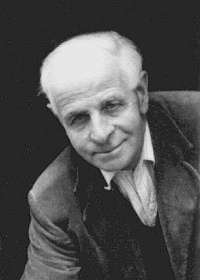
The mistletoe hung on the castle wall,
The holly branch shone on the old oak wall
And the baron's retainers were blithe and gay,
They were keeping their Christmas holy day.
And the baron reviewed, with a fatherly pride,
The beautiful child, young Lovel's bride
While she with her bright eyes seemed to be
The star of the goodly company
Oh the mistletoe bough, oh the mistletoe bough.
"I'm tired of dancing now", she cried
"Here tarry a moment, I'll hide, I'll hide
And Lovel, be sure thou art first to trace
The clue to my secret hiding place."
Away she ran, and the chase began
Each corner to search and each nook to scan
And young Lovel cried "Oh where dost thou hide?
I'm lonesome without thee, my fairy bride"
Oh the mistletoe bough, oh the mistletoe bough.
They sought her that night, they sought her next day
They sought her in vain 'til a week passed away
O'er the highest, the lowest, the lowliest spot
Young Lovel sought vainly, yet found her not
The long years rolled by and our grief at last
Was told as a sorrowful tale of the past
When Lovel appeared, the children all cried
"See the old man weeps for his fairy bride
Oh the mistletoe bough, oh the mistletoe bough.
At length an old chest that had long lain hid
Was found in the castle, and they raised the lid
A skeleton form lay mouldering there
And the bridal wreath of a lady fair
Oh sad was her fate, for in sportive jest
She hid from her lord in an old oak chest
It closed with a spring and the bridal bloom
Lay clasped there in a living tomb
Oh the mistletoe bough, oh the mistletoe bough.
Written in the early 1830s by Thomas Haynes Bayly (who also wrote the words of Home Sweet Home), with music by Sir Henry Bishop, this ballad has been extremely popular throughout southern England and the USA and appears in a number of popular song books and ballad sheets. It relates well to the novels of Sir Walter Scott and the general Gothic Novel movement. Roud has 70 versions, almost all from broadsides, with only eight recorded examples - George Townshend sings it on Come, Hand to Me the Glass (MTCD304). It is still very popular in Yorkshire carolling pubs.
One must assume that the element of pastiche in the song (trying hard to seem an older song than it actually is) meant that the earlier English collectors ignored it (for they surely must have encountered it), since it appears only in Henry Burstow's listing of his songs in Reminiscences of Horsham.
In Everyman's Book of British Ballads, Roy Palmer says: "There is a tradition that this ballad was inspired by an, event at Exton Hall, Rutland, in the early eighteenth century. The owner's daughter, Catherine Noel, aged eighteen, got into a large chest during a game of hide and seek, or, as another story has it, a performance of Romeo and Juliet. She was unable to re-open the lid, and was suffocated before she could be released.
16 On a See-Saw (melodeon)
A tune from a 1930s' stage play called Jill Darling. It was sung as a duet by John Mills and Louise Brown. Mike Yates suspects that Walter heard it on the radio, presumably from a 78rpm recording. My remarks (see CD 2, Track 3) about the omission of pauses in East Anglian playing of song tunes also applies here.
17 Your Faithful Sailor Boy (Roud 376, Laws K13)
'Twas on a cold and stormy night, when snow lay on the ground
A sailor boy stood on the quay, his ship was outward bound
His sweetheart standing by his side shed many a silent tear
And as he pressed her to his breast, he whispered in her ear ...
Chorus:
Farewell, farewell, my own true love, this parting gives me pain
I'll be your own true guiding star, 'til I return again
My thoughts will be of you, of you, when storms are raging high
Farewell, farewell, remember me, your faithful sailor boy.
Within the gale the ship set sail, he kissed his love goodbye
She watched the craft 'til out of sight, a tear bedimmed her eye
She prayed to Him in Heaven above to guard him on his way
Their loving parting words that night re-echo o'er the bay ...
But, sad to say, the ship returned without her sailor boy
He died upon the voyage with the flag at half-mast high
His comrades, when they came on shore, they told her he was dead
The letter that he wrote to her, these last lines sadly said ...
Farewell, farewell, my own true love, on earth we'll meet no more
Full-soon I'll be from storm and sea, on that eternal shore
I hope to meet you in that land, that land beyond the skies
Where you will not be parted from your faithful sailor boy.
The Faithful Sailor Boy was written by G W Persley towards the end of the 19th century. Few songs have achieved such widespread popularity among country singers and their audiences. It turns up again and again in pub sing-songs throughout Britain, even through into the 1990s.
Gavin Greig described it as being 'Very popular in Aberdeenshire in the early years of this century' and, sure enough, Daisy Chapman had it in her repertoire, as will be heard on the forthcoming Musical Traditions record (MTCD308 - probably out in mid-July, 2000).
We have heard it sung in both Donegal and Cork in the last few years - indeed, it has been published without comment in Irish Ballads and Songs of the Sea by James N Healy, Mercier 1967. Two versions have been found in the North Carolina mountains (there's a '20s hillbilly recording by Flora Noles, Sailor Boy's Farewell - Okeh 45037), while other sets have been reported from as far away as Australia and Tristan da Cunha. Cyril Poacher sings it on Plenty of Thyme (MTCD303), and it was also one of Percy Webb's favourite songs, and could be heard on the Topic LP Flash Company (12TS243).
18 Here's to the Grog (All for Me Grog) (Roud 475)
I've got a good old cap, boys, a cap boys, you see
A cap that you wear in cold weather
With the peak all out and the lining flying about
Was done through the cold frosty weather.
Chorus:
Here's to the grog, boys, jolly, jolly grog
Here's to the wine and tobacco
I've spend all my tin on the ladies drinking gin
An' across the briny ocean I must wander.
I've got a good old coat, boys, a coat boys, you see
Coat that you wear in cold weather
With the pockets all out and the lining flying about
Was done through the cold frosty weather.
I've got a good old jacket, boys, a jacket boys, you see
Jacket you wear in cold weather
With the pockets all out and the lining flying about
It's done through the cold frosty weather.
I've got some good old trousers, boys, trousers boys, you see
Trousers you wear in cold weather
With the flies all out and the buttons flying about
It is done through the cold frosty weather.
That's as much as I know of that, Mike ... I don't know, what, is there another?
This song is almost only found in England - scattered the length and breadth of the country - aside from three examples from Australia and one each from Canada and Scotland. Only George 'Tom' Newman of Clanfield, Oxfordshire and George Collinson of Hull, Yorkshire are known to have recorded it apart from Walter.
19 Nancy Lee (Roud 5014)
Of all the wives that e'er ye know
Ye-ho lads, oh, ye-ho lads, oh
There's none like lovely Nancy Lee, I trow
Ye-ho lads, oh, ye-ho
See, there she'll stand and wave her hand, upon the quay
And every day, when I'm away, she watch for me
And whisper low when tempests blow for Jack at sea
Ye-ho lads, oh, ye-ho.
Chorus:
The sailor's wife the sailor's star shall be
Ye-ho, we go across the sea
The sailor's wife the sailor's star shall be
The sailor's wife his star shall be.
The harbour's past and the breezes blow
'Tis long e'er we come back I know
But true and bright from morn 'til night my home will be
And all so trim and snug and neat for Jack at sea
And Nancy's face to bless the place and welcome me ...
The Bosun pipes the watch below
Then here's a health afore we go
"Here's long, long life to my sweet wife and mates at sea
And keep our bones from Davy Jones where e'er we be
May you all meet a mate as sweet as Nancy Lee ...
A very unusual song to find in England, since it's an American sailors' song. Roud has but three instances of it and it only appears to have been collected by Alton C Morris, from a Miss Elsie Surber of Panama City, Florida and published in Morris, Folksongs of Florida pp.58-59. Henry Burstow has its title listed, but we have no way of knowing if his was the same song.
Whatever - it's a lovely song with a truly gorgeous tune with its extra long measures in the middle lines, and it's one of my favourites of all the 49 on these two CDs. That last verse appeals to all the very worst of my romantic sentimentality, and brings a tear to the eye every single time I listen to it! It is also unusual in that it discusses the sailor's wife in terms that have none of that edge of disparagement or snide humour which so often mars songs of this kind - it seems astonishing that this is the first time it has been published on record.
20 Up the Chimney Pot (Roud 240) / Slave Driving Farmers (Roud 13645) / Bound to Emigrate to New Zealand (Roud 13637) (fragments)
On the chimney pot, you old bitch
Fol-the-rol, fol-the-rol
Chimney pot, you old bitch
Fol-the-rol, fol-the-rol
You're the sweetest old man alive, live, live
You're the sweetest old man alive.
Chamber lie, you old bitch
Fol-the-rol, fol-the-rol
Chamber lie, you old bitch
Fol-the-rol, fol-the-rol
You're the sweetest old man alive, live, live
You're the sweetest old man alive.
Another collection of fragments that Walter remembered. The first is a snatch of a song Sharp called Good Old Man. He noted a version of it from a Captain Lewis of Minehead in 1909, and two versions from the Appalachians - the second from the Ritchie Family of Kentucky. There is also a Welsh version printed in the JWFSS, Vol i, p 81. and another American set is in Vance Randolph's Ozark Folksongs, Vol 3, p. 117.
They would drive over poor folks who stand in the way.
You slave driving farmers, you pot-bellied farmers,
You're forced to give way to the labouring men
You slave driving farmers, you pot-bellied farmers,
You're forced to give way to the labouring men.
Fare-you well old boys, for really I must go.
Work it is so scarce and the wages are so low.
I'll cross the briny ocean, let it hail, rain, blow or snow.
I'm bound to emigrate to New Zealand.
Slave Driving Farmers, Bound to Emigrate to New Zealand and other labour and Union songs, and the circumstances surrounding them, are discussed in The Socio-political Songs of Walter Pardon in these pages - see Articles.
21 Husband Taming (Roud 13627)
Oh crikey, what a rummy go there'll be throughout the nation
So, married men, just mind your eye, you'll find an alteration
The women now are fully bent, and every day they're aiming
By hook or crook, they'll find a plan to give the men a taming
Chorus:
Hokey pokey, here's a go, the women they are aiming
To raise a new-invented plan - they call it husband taming.
There lives a man not far from here, they call him Billy Shingle
He says he'd give a thousand pounds, if he were only single
He says his wife has just begun to give him such a training
She's took a patent out to try the plan of husband taming.
In the mornings he must rise and kindle up the fire
Sift the cinders, empty the pots, it is her first desire
Then he must wash and dress the child and give the floor a sweeping
While his wife she lays in bed another hour a-sleeping.
And when the kettle it is boiled, he's ordered not to wake her
Until he's brought her nice hot rolls from Mr Snooks, the baker
Then he must go and lace her stays, it's no use his complaining
Because he knows it is the plan she's got for husband taming.
After breakfast, he must wash, while she goes out a-shopping
He must make the bed and hunt the fleas or else he gets a whopping
The napkins then, he's got to dry, and clean the breakfast table
And if he growls or says a word, she whops him with the ladle.
And if the neighbours should pop in, to let them see she's able
She makes him stand behind the chair and rock the baby's cradle
And if the child should chance to cry, she drives him nearly crazy
For he must take it up and sing "Oh, hush-a-bye-a-baby"
On Sunday, if she takes a walk, to see her cousin Atkins
In his best hat he's got to take a half a dozen napkins
So married men, judge for yourself, you see at what they're aiming
To wear the breeches out and out and give the men a taming.
So single men, just study this, if you would study riches
If ever you should take a wife, don't let her wear the breeches
If once she gets the breeches on, she'll give you such a training
And make you curse the patent plan they've got for husband taming.
Another very unusual song; nine of Roud's ten examples are from broadsides and there's no indication of its existence in the tradition - except for Walter's version. Where did the Gee family get all these unique songs?
The tenth example was published in Healy's Old Irish Street Ballads Vol 4, pp.129-130, but an Irish origin for the song seems unlikely in view of its first line 'Oh crikey, what a rummy go there will be through the nation'.
22 Uncle Walter's March (melodeon)
Mike Yates titled this tune Uncle Walter's March on his Home-Made Music LP301, but it may, in fact, be The Grand March that Walter mentions in his Knapton Drum and Fife Band article elsewhere in this booklet.
23 If I Ever Get Drunk Again (Roud 15131)
When you're standing with chums at the bar
Got a big buttonhole in your coat
A scaffold-pole penny cigar
And a tonic to gargle your throat
You're dodging all over the place
'Til it's time then to bust up the show
You're laughing all over your face
When they shout "Now, my lads, you must go"
Full of beer, pluck and mirth
You kid you're the happiest fellow on earth ...
Chorus:
But when you wake up in the morning
Oh, what a change you'll see
With a shoe-horn getting your cady* on
Your boots where your tie ought to be
And you're all topsy-turvy, murmuring your pain
"Oh may I go to Klondyke
If I ever get drunk again!"
Every girl that you meet on the way
It's "Goodnight, Miss" all the way home
'Til you know there's the Devil to pay
When up your own passage you roam
You stagger all over the shop
Quite silly, that's easy to prove
You murmur "I'll have one more drop ..."
In the finish, you find you can't move!
"Happy man on the job" you shout
"Why, I wouldn't peg out for two bob ..."
But when you wake up ...
"Oh may I sit on a nail
If I ever get drunk again!"
Next morning you roll out of bed
With a tongue swelled, all dry and all split
Hands all a-shake, and a head
A bushel basket won't fit
"No more bloomin' gargle for me!"
You swear, as you sit on your cot
But next night you are at it again
Like a fly round a big treacle pot
Comic songs stand and bawl,
Feel lively enough to run up a wall ...
But when you wake up ...
"Oh may the Missus have twins
If I ever get drunk again!"
Nothing, so far, is known about this song - except that it's fairly obviously a music hall piece - and, if you separate it from the words, it really is a rather splendid tune! This might be another song to come out of the East Anglian music hall 'pub circuit' mentioned above (see CD 2, Track 5). * Cady, or kadi, is a hat - possibly a word of Yiddish derivation.
24 Naughty Jemima Brown (Roud 1776)
'Twas at the railway station
Upon the Brighton line
I first met my Jemima -
Why should I call her mine?
He eyes were bright, her hair was light
Her dress a morning gown
A travelling box stood by her side
Upon it: 'Jemima Brown'
Chorus:
I used to take her everywhere
To all the sights in Town
And then she left me in despair
Did naughty Jemima brown.
At the babylinen [builders ?]
In the Burlington Arcade
I next saw Miss Jemima
As by the shop I strayed.
She looked a Queen of her sewing machine
And I spent many a crown
On collars and straps and baby's caps
To gaze on Jemima Brown.
I sought an introduction
Obtained it - all was right.
At eight o'clock I'd meet her
And walk home every night
To seal our love I bought her gloves,
To the creamery we went down,
Took tea and shrimps, drank bitter beer
And waltzed with Jemima Brown.
I flew one night to meet her
The weather, yet, was warm
I saw her friendly leaning
On a nice young feller's arm.
Against my will I felt quite ill
Enquiring with a frown
"Who's that?" "It's only brother Bill",
Said naughty Jemima Brown.
"I want to ask a favour
I hope you won't be cross
Or think it bad behaviour,
But Father had a loss.
Could you kindly lend us fifty pounds?
My brother he'll be bound"
Of course I would, could I refuse
My life to Jemima Brown?
From that very day I missed her,
Though she said she'd be my bride.
From Kennington to Chester
I sought her far and wide.
Years after that, when passing by
A shop in Camden Town
Midst heaps of greens and kidney beans
There stood Jemima Brown.
She was weighing out potatoes,
Throwing coppers in the till
Three lovely children by her side
The image of brother Bill
Her broken vow, I see it now,
But not my fifty pounds.
The shop was bought, and I was sold
By naughty Jemima Brown.
Yet another rarity; there's a broadside, three titles in catalogues and one in a book (Henry Burstow, again) - the only other known instance of its having entered the tradition. And a super song it is too, very well structured, and treading the line between comedy and tragedy with considerable skill.
25 The Dandy Man (Roud 1635)
When I was twenty years of age, a-courting I did go
All with a dandy barber's clerk, he filled my heart with woe
I never ceased to rue the day when I became his wife
He can do right by day nor night, 'tis true, upon my life.
Chorus:
Young women all, take my advice and mark what I do say
If ever you wed with a dandy man, you'll ever rue the day.
And when he goes to bed at night, like an elephant he lays
He never takes his breeches off, he sleeps in women's stays
His mouth is like a turnpike gate, his nose a yard 'n' a half
And if you saw his dandy legs, I'm sure they'd make you laugh.
It was upon last Christmas Day, as true as I'm a sinner
And as he stayed at home that day, he swore he'd cook the dinner
He took out all the plums and flour and mixed them in his hat
And in the pot upon the lot, the rogue he boiled some fat.
It was last Sunday morning, all by his own desire
My Leghorn bonnet and my cap, he took to light the fire
He took the tea things off the shelf, to clean off all the dirt
He washed them in the chamber pot and wiped them on his shirt.
One day, when I was very ill, he went to buy a fowl
He bought a pair, I don't know where - a magpie and an owl
He put them in the pot to boil, tied in a dirty cloth
He boiled the lot, all feathers and guts, and called it famous broth.
As we were walking up the street, 'twas arm in arm together
It very fast began to snow, he said "What rainy weather"
And if he saw a hackney coach, he'd swear it was a gig
He cannot tell, I do declare, a donkey from a pig.
Now you may talk of dandy wives, but tell me if you can
Where there's a dandy woman who can match a dandy man?
He's a dirty, roving, lazy fool and how I'd bless the day
That they would send my dandy man straight off to Botany Bay.
Although Roud has some 30 entries for this song (usually titled The Dandy Husband), 29 are broadside entries of some sort, the earliest of which was probably that printed by Pitts around 1815. The exception was Gardiner's collection, in 1906, from George Smith of Fareham, Hampshire, who only knew two and a half verses of the song. Clearly, the word 'dandy' had different connotations in the 19th century from those of today.
26 For Me, For Me (Roud 5393)
Down our street, there is a blooming riot
Five and twenty girls are waiting there
And the Police, they cannot keep them quiet
They won't go, for, you know, every maiden fair ...
For me, for me, she's waiting there for me
They can wait 'til a man can swear
There's not a tart near Leicester Square
Ha ha, he he, I'm not going there, you see
If anyone knows a trick or two, 'tis me, me, me!
Down our street, I met a country joskin
And I had him for his watch and chain
On his snout, I hit him such a cosher
He fell whack, on his back, down in Drury Lane.
For me, for me, he's waiting there for me
He can wait 'til his watch can walk
A blind man see and a dumb man talk
Ha ha, he he, I'm not going there, you see
If anyone knows a trick or two, 'tis me, me, me!
Our landlord, without any warning
Thought he'd try a modern sort of plan
He went round to my house this morning
With a stick, nice and thick, and a broker's man
For me, for me, he's waiting there for me
He can wait 'til the moon shines green
White hairs grow on a black man's chin
Ha ha, he he, I'm not going there, you see
If anyone knows a trick or two, 'tis me, me, me!
Down our street, there is a cabby waiting
And he thinks he's got a splendid fare
After several hours hesitating
I jumped out, for some stout, left him standing there
For me, for me, he's waiting there for me
He can wait 'til his horse drops dead
White hairs grow on a black man's head
Ha ha, he he, I'm not going there, you see
If anyone knows a trick or two, 'tis me, me, me!
Surprisingly, Roud's only other entry for this song is another sound recording - by George Fradley of Sudbury, Derbyshire and it can be heard on his Veteran Tapes cassette One of the Best (VT1 14). And again, it was Mike Yates who collected George, in 1984 - a couple of years after Walter. The song was written by Harry Wincott, with music by Joseph Tabrar. It was made popular in the late 19th century by the Music Hall singer Fred Earle.
27 While Shepherds Watched (Roud 936)
While shepherds watched their flocks by night
All seated on the ground - all seated on the ground
The Angel of the Lord came down
And glory shone - and glory shone around
And glory shone around - and glory shone around.
"Fear not" said He, for mighty dread
Had seized their troubled mind - had seized their troubled mind
Glad tidings of great joy, I bring
To you and all - to you and all mankind
To you and all mankind - to you and all mankind.
To you in David's town, this day
Is born on David's line - is born on David's line
A Saviour who is Christ the Lord and this shall be the sign
And this shall be - and this shall be the sign
And this shall be the sign - and this shall be the sign.
Almost certainly the most well-loved and most-sung hymn among ordinary English people, particularly in country areas. It also seems to boast a bewilderingly large number of tunes to which it may be sung - Walter's is called Lyngham. I'm told by someone who knows about these things that what Walter sings here is a combination of the tune and the first harmony part - just as anyone might who has heard the whole thing sung, but had not been formally taught to sing one or other of the parts.
One may imagine that few collectors asked for it to be sung, assuming it to be the 'normal' church version rather than a 'folk carol', and Roud only lists nine people from whom is has been collected. Of these, Bob Hart can be heard singing it on A Broadside (MTCD301-2), and Billy Harrison plays three different versions on Yorkshire Fiddle Tunes, Songs and Carols (MT Cass 201).
[Track List] [Introduction] [Walter Pardon] [In his own words] [Song tunes] [Recorded legacy][Knapton Drum & Fife Band] [Personality] [The Songs] [Discography] [Repertoire] [78rpm Listing] [Credits]

- EFDSS CD002
- Bright Golden Store
- Folkways FE38553
- The Deserter
- Lord Lovel
- The Maid of Australia
- Harmonium HM719
- The Trees they do Grow Hogh
- Home-Made Music LP301
- Blow the Winds I-O
- Bright Golden Store
- Caroline and her Young Sailor Bold
- Come Little Leaves
- Hold the Fort
- Naughty Jemima Brown
- Old Joe the Boat is Going Over (melodeon)
- The Parson and the Clerk
- The Poor Smuggler's Boy
- Rakish Young Fellow
- Rosin-a-Beau
- Thornaby Woods
- Two Jolly Butchers
- Uncle Walter's March (melodeon)
- Leader LED2063
- A Ship to Old England Came
- A British Man-of-War
- The Dark-Eyed Sailor
- Jack Tar Ashore
- Let the Wind Blow High or Low
- The Miller and His Sons
- Old Brown' s Daughter
- The Poacher's Fate
- The Rambling Blade
- The Trees They Do Grow High
- Van Diemen's Land
- Leader LED2111
- Balaclava
- Down By the Dark Arches
- Grace Darling
- I'll Beat the Drum Again (The Female Drummer)
- I'll Hang my Harp on a Willow Tree
- Jones's Ale
- The Old Miser
- The Pretty Ploughboy
- Up to the Rigs (of London Town)
- The Wreck of the Ramillies
- You Generals All (Lord Marlborough)
- Musical Traditions MT CD 305
- All Among the Barley
- Black-eyed Susan
- Blow the Winds I-O
- The Bonny Bunch of Roses-O
- Caroline and Her Young Sailor Bold
- A Country Life
- Cupid the Pretty Ploughboy
- The Green Bushes
- Hold the Fort
- If I Were a Blackbird
- I'm Yorkshire Though in London
- Little Ball of Yarn
- Lord Lovel
- An Old Man's Advice
- The Parson and the Clerk
- Polly Vaughan
- The Poor Smuggler's Boy
- The Saucy Sailor
- Seventeen Come Sunday
- The Skipper and his Boy
- Thornaby Woods
- Musical Traditions MT CD 306
- Alice Grey
- Ben Bolt
- Bound to Emigrate to New Zealand
- Cock-a-Doodle-Do
- The Cuckoo
- The Dandy Man
- Down by the Old Abbey Ruins
- For Me, For Me
- The Harland Road
- Here's to the Grog
- The Huntsman
- Husband Taming
- If I Ever Get Drunk Again
- The Marble Arch
- The Mistletoe Bough
- Nancy Lee
- Naughty Jemima Brown
- Not for Joseph, Not for Joe
- The Old Armchair
- Old Joe the Boat is Going Over
- On a See-Saw
- Put a bit of Powder on it, Father
- Rosin-a-Beau
- Saving Them All for Mary
- Slave Driving Farmers
- Two Lovely Black Eyes
- Uncle Walter's March
- Uncle Walter's Tune
- Up the Chimney Pot
- Wake Up Johnny
- When the Cock begins to Crow
- Wheel Your P'rambulator
- While Shepherds Watched
- Your Faithful Sailor Boy
- People's Stage Tapes 11
- At Rambling Green
- Balaclava
- Down by the Dark Arches
- I'll Hang my Harp on a Willow Tree
- The Maid of Australia
- Old Brown's Daughter
- The Parson and the Clerk
- The Pretty Ploughboy
- The Rakish Young Fellow
- The Reason Why (One Cold Morning in December)
- The Rich Irish Girl (Let the Winds Blow High or Low)
- Up to the Rigs of London Town
- Van Diemen's Land
- Root and Branch CD1
- Won't You Come to Me in Canada
- Topic 12TS392
- A Country Life
- An Old Man's Advice
- The Bold Princess Royal
- The Broomfield Wager
- Cupid the Ploughboy
- The Dandy Man
- The Devil and the Farmer's Wife
- The Hungry Army
- I Wish, I Wish
- Jack Hall
- One Cold Morning in December
- Peggy Bawn
- Raggle Taggle Gypsies
- Uncle Walter's Tune
- Topic TSCD514
- The Banks of Sweet Dundee
- The Bold Fisherman
- The Bold Princess Royal
- A British Man of War*
- The Cunning Cobbler
- The Dark-Eyed Sailor*
- The Deserter
- The Devil and the Farmer's Wife
- The Female Drummer*
- The Handsome Cabin Boy
- The Jolly Wagoner
- The Lawyer (Mowing the Barley)
- The Loss of the Ramilies*
- Maids of Australia
- The Pretty Ploughboy*
- The Rakish Young Fellow
- The Rambling Blade*
- The Trees They do Grow High*
- Two Jolly Butchers
- Topic TSCD600
- The Broomfield Wager
- Topic TSCD651
- Peggy Bawn
- Topic TSCD652
- A Ship to Old England Came*
- Jack Tar Ashore*
- Topic TSCD654
- Van Diemen's Land*
- Topic TSCD656
Raggle Taggle Gypsies
- Topic TSCD660
Let the Wind Blow High or Low*
- Topic TSCD664
The Hungry Army
- Topic TSCD665
I Wish, I Wish
One Cold Morning in December
- Topic TSCD667
Jack Hall
- Topic TSCD668
The Poacher's Fate*
- Veteran Tapes VT108
Spanish Ladies
Sons of Labour
- Veteran Tapes VT109
Black-Eyed Susan
The Topman and the Afterguard
- Veteran Tapes VTC1CD
Sons of Labour
Notes:
Songs marked with an
asterisk on Topic CDs are alternate takes to the same songs issued on Leader albums.
VT108/9 are cassettes.
MT CDs 305 and 306 are issued together as a double set.
Walter Pardon knew at least 182 songs. The number of the record on which a song has been published is shown after the title - full details of these records can be found in the Discography section following this one. The word 'tape' after a song indicates that it is known to have been recorded, but not published.
A Country Life - 12TS392 / MTCD305
A Picture No Artist Can Paint
A Ship to Old England Came - LED2063 / TSCD652
Alice Grey - MTCD306
All Among the Barley - MTCD305
All Jolly Fellows that Follow the Plough - tape
An Old Man's Advice - 12TS392 / MTCD305
As I Wandered by the Brookside - tape
Balaclava - LED2111 / PST11
The Banks of Allen Water
The Banks of Loch Lomond
The Banks of the Sweet Dundee - TSCD514
The Banks of the Nile (Trouble in my Native Land)
Ben Bolt - MTCD306
Black-Eyed Susan - VT109 / MTCD305
Blow the Winds I-O - LP301 / MTCD305
Bluebell
The Bold Fisherman - TSCD514
The Bold Princess Royal - 12TS392 / /TSCD514
The Bonny Bunch of Roses-O - MTCD305
Bound to Emigrate to New Zealand - MTCD306
Boys of the Old Brigade
Break the News to Mother
Bright Golden Store - LP301 / CD002
A British Man-of-War - LED2063 / TSCD514
The Broomfield Wager - 12TS392 / TSCD600
By the Side of the Zuider Zee
Carolina Moon
Caroline and Her Young Sailor Bold - LP301 / MTCD305
Cock-a-Doodle-Do - MTCD306
Come Little Leaves - LP301
The Cuckoo - MTCD306
The Cunning Cobbler - TSCD514
Cupid the Ploughboy - 12TS392 / MTCD305
The Dandy Man - 12TS392 / MTCD306
The Dark-Eyed Sailor - LED2063 / TSCD514
The Deserter - FE38553 / TSCD514
The Devil and the Farmer's Wife - 12TS392 / TSCD514
Don't Go Down the Mine Dad
Down by the Dark Arches - LED2111 / PST11
Down by the Old Abbey Ruins - MTCD306
The Farmer's Boy
The Farmer's Boy (Parody) - tape
The Female Cabin Boy - TSCD514
For Me, For Me - MTCD306
Galway Bay
Go and Leave Me if You Wish It - tape
The Golden Wedding
The Good Rhine Wine - tape
The Gooseberry Tree - tape
Grace Darling - LED2111
Grandfather's Clock
Green Bushes - MTCD305
The Harland Road - MTCD306
Help One Another Boys - tape
Here's to the Grog - MT CD 306
Hold the Fort - LP301 / MTCD305
The Hungry Army - 12TS392 / TSCD664
The Huntsman - MTCD306
Husband Taming - MTCD306
I Don't Care if there's a Girl There - tape
I Traced Her Little Footprints in the Snow - tape
I Want to See the Old Home Again - tape
I Wish, I Wish - 12TS392 / TSCD665
I Wonder if You Miss Me Sometimes? - tape
If I Were a Blackbird - MTCD305
If I Ever Get Drunk Again - MTCD306
If Those Lips Could Only Speak - tape
I'll Beat the Drum Again (The Female Drummer) - LED2111 / TSCD514
I'll Hang My Harp on a Willow Tree - LED2111 / PST11
I'll Take You Home Again, Kathleen
I'll Walk Beside You
I'm Saving them all for Mary - MTCD306
In the Shade of the Old Apple Tree
Irish Molly-O - tape
It's Hard to Say Goodbye - tape
Jack Hall - 12TS392 / TSCD667
Jack Tar Ashore - LED2063 / TSCD652
Jackie Boy, Master (The Keeper) - tape
The Jolly Wagoner - TSCD514
Jones's Ale - LED2111
Just a Song at Twilight
The Lads in Navy Blue - tape
The Lawyer - TSCD514
Let the Wind Blow High or Low (The Irish Girl) - LED2063 / TSCD660 / PST11
Little Ball of Yarn - tape
Little Grey Home in the West
Little Old Log Cabin in the Lane - tape
Long, Long Trail a-Winding - tape
Lord Lovel - FE38553 / - MTCD305
The Maid of Australia - FE38553 / TSCD514 / PST11
The Man Who Broke the Bank at Monte Carlo
The Marble Arch - MTCD306
The Men of Merry England
The Miller and His Sons - LED2063
The Miner's Dream of Home
The Minstrel Boy
The Mistletoe Bough - MTCD306
Mother Machree
My Wild Irish Rose
Nancy Lee - MTCD306
Naughty Jemima Brown - LP301 / MTCD306
Not for Joe, Not for Joseph - MTCD306
The Old Arm Chair - MTCD306
Old Brown's Daughter - LED2036 / PST11
Old Joe the Boat is Going Over- LP301 / MTCD306
Old King Cole - tape
The Old Miser - LED2111
Old Parson Brown - tape
Old Rustic Bridge by the Mill - tape
One Cold Morning in December- 12TS392 / TDSC665
Only a Beautiful Picture in a Beautiful Golden Frame
Off to Philadelphia
The Parson and the Clerk - LP301 / PST11 / MTCD305
Peggy Bawn - 12TS392 / TDSC651
Peggy O'Neil
Polly Vaughan - MTCD305
The Poacher's Fate - LED2063 / TSCD668
Poor Rodger is Dead - tape
Poor Smuggler's Boy - LP301 / MTCD305
The Pretty Ploughboy - LED2111 / TSCD514
Put a Bit of Powder on it Father - MTCD306
Raggle Taggle Gypsies - 12TS392 / TSCD656
Rakish Young Fellow - LP301 / TSCD514 / PST11
The Rambling Blade - LED2063 / TSCD514 / PST11
Ring the Bell Watchman - tape
Ring, Ring the Bell - tape
Robin Adair
Roman Soldiers - tape
Rosin-a-Beau - LP301 / MTCD306
The Saucy Sailor - MTCD305
Seventeen on Sunday - MTCD305
She Stood in a Working Man's Dwelling - tape
Shepherd of the Hills - tape
The Ship that Never Returned - tape
Sitting on the Stile, Mary - tape
Skipper and His Boy - MTCD305
Slave-Driving Farmers - MTCD306
Smiling Through
Sons of Labour - VTC1CD
Spanish Ladies - VT108
The Steam Arm - tape
Sweet Marie - tape
Sweetheart May
Teddy O'Neil
There's a Light in the Window
There's No Place Like the Old Home
There is Somebody Waiting for Me
The 39-45 Star - tape
Thornaby Woods - LP301 / MTCD305
Tommy, Make Room for Your Uncle - tape
The Top Man and the After Guard - VT109
The Trees they Do Grow High - LED2063 / TSCD514 / HM719
Two Jolly Butchers - LP301 / TSCD514
Two Little Girls in Blue
Two Lovely Black Eyes - MTCD306
Up the Chimney Pot - MTCD306
Up to the Rigs (of London Town) - LED2111 / PST11
Van Diemen's Land - LED2063 / TSCD654 / PST11
Wake up, Johnny - MTCD306
The Wanderer - tape
We'll All Go the Same Way Home
Wheel Your P'rambulator - MTCD306
When the Cock Begins to Crow - MTCD306
When the Fields are White with Daisies - tape
When the Great Red Dawn is Shining
When I Wore a Tunic - tape
When the Poppies Bloom Again
When They Ask You What Your Name Is
When You Get up in the Morning - tape
When You Wore a Tulip
While Shepherds Watched - MTCD306
Will You Love Me in December?
Won't You Come to Me in Canada? - CD1
Woodman Spare that Tree - tape
The Wreck of the Lifeboat
The Wreck of the Ramillies - LED2111 / TSCD5 14
Write Me a Letter from Home
Yellow Rose of Texas
Yorkshire Though in London - MTCD305
You Generals All (Lord Marlborough) - LED2111
Your Faithful Sailor Boy - MTCD306
A Listing of Walter's 78rpm gramophone records:
| Broadcast 738 | Charlie Higgins | Down in the Fields Where the Buttercups All Grow / Running up and Down the Street
|
| Brunswick 05000 | Bing Crosby | By the Light of the Silvery Moon / Beautiful Dreamer
|
| Columbia DB2153 | .. | Let's Spend an Evening at Home / Some Day We'll Meet Again
|
| Columbia DB2515 | Bill Johnson | Galway Bay / Down by the Old Mill Stream
|
| Columbia 5490 | Richard Hayward | Bonny Bunch of Roses / The Old Orange Flute
|
| Decca F.2309 | Liam Walsh | Three Hornpipes / Two Irish Reels
|
| Decca F.2493 | Cliff Connolly | Little Town in the Ould County Down / When They Ask You What Your Name Is
|
| Decca F.3388 | Paddy Malone & His Accordion Band | Hornpipes / Scottish Reels
|
| Decca F.3785 | Mac & Bob | A Picture No Artist Can Paint / Little Log Cabin in the Lane
|
| Decca F.7898 | Vera Lynn | Smiling Through / I'll Walk Beside You
|
| Decca F.8602 | The Squadronnaires | Kentucky / Nancy
|
| HMV B.3391 | Sean Nolan's Dublin Orchestra | When the Kettle Boils Over & Haste to the Wedding / Donnal's Favorite (Hornpipe)
|
| HMV B.3609 | Dan Sullivan's Shamrock Band | Irish Set Dance / Pts. 3-4
|
| HMV B. 8497 | Paul Robeson | Ol' Man River / I Still Suits Me
|
| HMV B.8830 | .. | Trees / Songs My Mother Taught Me
|
| Parlophone E3061 | Emmet O'Mara Patrick Jordan | The Wearing of the Green God Save Ireland
|
| Parlophone E3558 | Dennis Cox | Bantry Bay / The Sunshine Sailed Away from Killarney
|
| For the following discs RZ = Regal Zonophone.
|
| RZ 6073 | Zonophone Concert Quartette (sic) | Robin Adair / Under the Greenwood Tree
|
| RZ G6305 | Robert Howe | The Miner's Dream of Home / Homeland Good-Bye
|
| RZ G6514 | William Thomas | I'll Take You Home Again, Kathleen / The Blind Boy
|
| RZ G6523 | Kenneth Walters | The Old Rustic Bridge by the Mill / The Vacant Chair
|
| RZ G6930 | William Thomas | When the Fields are White with Daisies / Where the Sunset Turns the Ocean's Blue to Gold
|
| RZ G6986 | Peter Wyper | Selection of Hornpipes, CliffHornpipe and Harvest Home / Queen Mary Waltz
|
| RZ G9184 | O'Leary's Irish Minstrels | The Girl I Left Behind Me & The White Cockade / The Campbells are Coming & Garry Owen
|
| RZ MR246 | The Flanagan Brothers | The Wanderer Medley / Finnegan's Ball
|
| RZ MR934 | Jack Daly | Grandfather's Chair / Mullingar
|
| RZ MR1107 | Joe Flanagan | Sunshine & Off to California (Hornpipes) / The Half Crown Song
|
| RZ MR1429 | Grand Massed Brass Bands | Sweethearts of Yesterday / Pts. 3 - 4
|
| RZ MR1435 | Bertha Willmot / Denis O'Neil | Pts 1 & 2
|
| RZ MR1780 | Jack Daly | A Little Dash of Dublin / A Portrait of a Lady
|
| RZ MR1822 | .. | Don't Be Ashamed of the Old Folks / Leave Me With a Love Song
|
| RZ MR1856 | .. | Smilin' Through / That's How I Spell I.R.E.L.A.N.D
|
| RZ MRl919 | .. | When Irish Eyes are Smiling / An Old Irish Lady
|
| RZ MR1957 | .. | Little Town in the Ould County Down / Danny Boy
|
| RZ MR2144 | .. | Au Revoir / Laughing Irish Eyes
|
| RZ MR2207 | The Hill Billies | Memories of the Old Homestead. Pts. 1 & 2
|
| RZ MR2230 | Grand Massed Bands of l936 | Home Land Melodies Pts. 1 & 2
|
| RZ MR2271 | Jack Daly | When the Poppies Bloom Again / With My Shillelagh Under My Arm
|
| RZ MR2286 | .. | As Irish as Irish Can Be / Did Your Mother Come from Ireland?
|
| RZ MR2369 | .. | The Charladies' Ball / My Heart's in Old Killarney
|
| RZ MR2471 | .. | Biddy O'Brien / The Daughter of Mother Machree
|
| RZ MR2493 | .. | Rose of Tralee / The Mountains of Mourne
|
| RZ MR2517 | .. | Let Us be Sweethearts Over Again / Shake Hands with a Millionaire
|
| RZ MR2546 | .. | Stage Show Medley Pts 1 & 2
|
| RZ MR2568 | .. | It Looks Like Rain in Cherry Blossom Lane / Goodnight to You All
|
| RZ MR2580 | The Comerford Trio | Set Dance & Job of Journeywork / Jigs
|
| RZ MR2599 | Jack Daly | Little Old Lady / In the Mission by the Sea
|
| RZMR2600 | .. | At Danny O'Dochelty's Dance / A Little Bit of Ireland
|
| RZ MR2686 | .. | My Wild Irish Rose / It Takes an Irish Heart to Sing an Irish Song
|
| RZ MR2711 | .. | Outside an Old Stage Door / Somebody's Thinking of You Tonight
|
| RZ MR2751 | .. | Meet Me Down in Sunset Valley / It's Better to Have Loved and Lost
|
| RZ MR2773 | .. | With Me Ould Clay Pipe / When Granny Wore Her Crinoline
|
| RZ MR2797 | .. | When the Organ Played 'O Promise Me' / Over the Hill
|
| RZ MR2833 | .. | Sweet Irish Sweetheart of Mine / Take Me Back to Ireland
|
| RZ MR2894 | .. | The Sweetest Song in the World / Love Makes the World Go Round
|
| RZ MR2916 | .. | Meet Me Down in Sunset Valley / Any Broken Hearts to Mend?
|
| RZ MR2963 | .. | When I'm Old and Grey / Where the Shannon Flows Down to the Sea
|
| RZ MR2974 | .. | Phil the Fluter's Ball / An Irish Lullaby
|
| RZ MR3025 | .. | Mother Machree / That Old Irish Harp in Kildare
|
| RZ MR3040 | .. | I Still Think of You, Sweet Nelly Dean / You've Always Been a Pal
|
| RZ MR3041 | .. | I Paid for the Lie that I Told You / Dixie Mammy
|
| RZ MR3066 | .. | We've Come a Long Way Together / Summer Sweetheart
|
| RZ MR3087 | .. | When They Ask You What Your Name Is / Ireland Must be Heaven
|
| RZ MR3168 | .. | I'll Remember / A Mother's Prayer at Twilight
|
| RZ MR3210 | .. | My Irish Home Sweet Home / If You're Irish Come into the Parlour
|
| RZ MR3238 | .. | I'll Pray for You / 'Neath the Shanty Town
|
| RZ MR3269 | .. | When the Rose of Tralee Met Danny Boy / Rainbow Valley
|
| RZ MR3489 | .. | The Old House / Forever and a Day
|
| RZ MR3552 | .. | Terence's Farewell to Kathleen / The Irish Emigrant (I'm Sitting on the Stile, Mary)
|
| RZ MR3612 | .. | Rose O'Day / The White Cliffs of Dover
|
| RZ MR3687 | .. | Off to Philadelphia / The Dear Little Shamrock
|
| RZ T.5710 | Herbert Thorpe | Kathleen Mavoureen / Eileen Alannah
|
| RZ T.5791 | Zonophone Salon Orchestra | A Paradise for Two / Maid of the Mountains
|
| RZ T.6240 | Frank Lee's Tara Ceildh Band | Irish Hornpipes / Irish Reels
|
| Rex 8031 | Big Bass Sambo | In the Valley of the Moon / When it's Moonlight on the Swanee
|
| Rex 8093 | Florrie Forde | Selection of Old Time Hits
|
| Rex 8130 | Carson Robison & His Pioneers | Home on the RangelDarling Nelly Gray
|
| Rex 8136 | Master Joe Petersen | Love's Old Sweet Song / White Wings
|
| Rex 8254 | Maurice Edwin | The Volunteer Organist / The Lost Chord
|
| Rex 8273 | Holme Valley Male Voice Choir | Loch Lomond / On the Banks of Allen Water
|
| Rex 8386 | Joe Petersen | The Song that Reached My Heart / Won't You Buy My Pretty Flowers?
|
| Rex 8785 | .. | The Old Rustic Bridge by the Mill / If Those Lips Could Only Speak
|
| Rex 9092 | .. | For Old Time's Sake / Vagabond Fiddle
|
| Rex 9095 | Gracie Fields | I Never Cried so Much in all My Life / Smile When You Say Goodbye
|
| Rex 9104 | Jay Wilbur | In an Old Cathedral Town / The Greatest Mistake of My Life
|
| Winner 3823 | The Elliots | Shores of Minnetonka / Sweet Indiana Home
|
| Zonophone GO81 | Sir Harry Lauder | I Love a Lassie / When I Get Back Again to Bonny Scotland
|
| Zonophone GO100 | .. | Somebody's Waiting for Me / Bonnie Wee Annie
|
| Zonophone 5470 | Madam Megan Telini | The Heart of a Rose / I Passed By Your Window
|
| Zonophone 5541 | Tommy Sandilands | Come Back to Erin / Because
|
| Zonophone 5708 | Black Diamonds Band | Boys of the Old Brigade / Guards Parade
|
| Zonophone 5890 | Barrington Hooper | When My Caravan Has Rested / Lorraine
|
| Zonophone 6155 | International Novelty Quartette | Silver Bell / Do You Miss Me in the Dear Old Homeland
|
Much of the above information is culled from the writings of Mike Yates and Reg Hall, particularly in the booklet notes to Topic Records' Walter Pardon CD A World Without Horses (TSCD514) and their Voice of the People series. It is used with permission.
Quotations from Walter himself are taken mainly from transcriptions of conversations with Peter Bellamy (published in Folk Review, August 1974, pp.10-15) and Karl Dallas (published in Folk News, August 1977, pp.14-15).
The Knapton Drum and Fife Band article was written by Walter Pardon, and originally published in Folk Roots magazine, No 28, October 1985. It is used with permission.
The recordings were all made by Mike Yates, who also wrote the first part of the Introduction, the Personality and Recorded Legacy sections, complied the Repertoire, Discography and 78rpm Collection sections, took some of the photographs and made valuable additions to the song notes.
My sincere thanks to Mike, and to everyone else who has helped in different ways to make this project a reality:
- Malcolm Taylor - at the Vaughan Williams Memorial Library, for unstinting and good-humoured help with the recordings, information, encouragement .......
- Andrew King - for copying dozens of sound files ... and inadvertently forcing me to make this a double CD.
- Steve Roud - for additions to the song notes and for providing MT with a copy of his Folksong and Ballad Indexes, whence came a lot of the historical information on the songs.
- Danny Stradling - for proof-reading and help with the song transcriptions.
- Fred McCormick - for additions to the song notes.
- Sylvia Pitcher and Frank Weston - for some of the photographs.
- Paul Goodfellow - for a photograph
- Pat Mackenzie - for a photograph
- Janet Topp-Fargion and Clare Gilliam - of the NSA for help with locating some recordings.
- Tony Engle - at Topic Records, for co-operation, permissions and access to some of the photographs.
- Ian Anderson - at fRoots magazine, for permissions.
Having listened at some length to all 49 songs on these two CDs, many of which I had never heard before, the lasting impression is of how many really lovely tunes there are. The texts of one or two of them may be of less merit or interest, but at least 90% are supported by tuneful, singable, memorable melodies. No wonder Walter used to while away the hours playing them on the melodeon and keeping them going for so long in isolation. We are all very much in his debt for his sharing them with us.
Booklet: some text, all editing, DTP, printing; CD: formatting, digital editing, production - by Rod Stradling, Spring 2000
A Musical Traditions Production © 2000
Rod Stradling and Mike Yates - 20.5.00
Article MT052
[Track List] [Introduction] [Walter Pardon] [In his own words] [Song tunes] [Recorded legacy][Knapton Drum & Fife Band] [Personality] [The Songs] [Discography] [Repertoire] [78rpm Listing] [Credits]
Site designed and maintained by Musical Traditions Web Services Updated: 6.10.00