
|
|
Letters: 2007 |
I learned this weekend of the death of Helen Cumming at the hand of her father on December 20, 1910, and the folk song that arose from it, from your article (article MT 165). It was most interesting.
One of the 'bairnies' that witnessed the gruesome murder, ran to warn the police, then testified against his father was George Cumming, was my maternal step-grandfather, who died in 1988 at the age of 87. He and his four brothers were sent to Canada in 1913 as part of a Quarrier's party of 'orphans' indentured to farmers in Canada. Three of the boys remained in Canada, and one emigrated to the U.S.
My grandfather never spoke about this episode in his life. He only said that his mother had died, and his father could not keep them, so committed them to the Quarrier's orphanage nearby. My aunt only discovered this story after her father's death. She will find your article interesting as the original articles that appeared in the Huntly Express in 1910 and 1911.
Regards,
Jamie Trimble - 12.12.07
Ontario, Canada
Looking forward to reading your responses,
Fay Hield - 4.12.07
f.hield@sheffield.ac.uk
Am looking for online (links) or offline (books) sources on ECD percussion kit setup and playing. I have good familiarity with both traditional and more modern bands (Plain Capers to Tiger Moth, say) and have the sound of ECD percussion in my ear, but would welcome specific information about drum setups and playing techniques. I have a young drumset and drumline player with good skills but who needs direction in ECD playing.
Thanks for any info, offlist at christopher d o t smith a t ttu dot edu
Chris Smith - 3.10.07
Even recordings of such traditional gems as the wonderful Kokatahi Band are now unobtainable. This was and still is a loose knit group of ex-miners and friends from Hokitika in the South Island which has been going for very many years.
In the past I understand that Radio New Zealand used to have a vast collection of disk recordings of interviews from such people as old-time bullock drovers. Like the BBC archival records were of little interest to RNZ and as far I understand it they junked the lot in the 1960/70s. I did hear that Phil Garland rescued some of these recordings. Perhaps he needs encouragement to publish these onto the web?
Some of the surviving NZ folklore was in bush ballads or recitations. These were published in vast quantities. Many of these collections are still available. These were poems of local life and events in the 1800s/1900s. They were recited at logging camps and in local shanties (pubs) to earn a drink for the night. They were performed at social gathering of all kinds. They were the real folk tradition of New Zealand.
Such a writer of these was one Charles Thatcher; see: http://www.teara.govt.nz/1966/T/ThatcherCharlesRobert/ThatcherCharlesRobert/en
As far as recent folklore is concerned the RNZ programmes 'Open Country' by Jim Henderson related tales from ordinary folk and their experiences in the early and mid part of the 1900s. Some of the stories were published in book form, but none are available on-line. I suspect that these have been wiped. These programmes would have been a cornucopia of stories of life in pioneering days. As an aside I purchased and still have vast numbers of 5¼" reels of audio tape from RNZ - all wiped before being sold. I hate to think what gems were on them.
However all is not lost - one singer-song writer - Mike Harding - has been instrumental in researching native folk song. See: http://www.mikeharding.co.nz/
And somewhere there is a complete collection of ALL performances at Devonport Folk Club. See: http://devonportdirectory.co.nz/realmusic.htm They must have vast archive of contemporary NZ folk song and singers.
Kiwi Pacific has a CD of performances at Poles Apart folk club. See: http://www.kiwipacific.com/product_info.php?products_id=173&osCsid=38543bca79cb95f62a1b8aa67fe84cfb
As for step dancing - the few old references we have is of one Ned Slattery otherwise known as The Shiner - see the wonderful book by John A. Lee called 'Shining with the Shiner.' Ned Slattery was an Irish itinerant in the mid-1800s. He was work-shy, lived on inspired trickery, and the stories John A Lee relates are very amusing. Slattery was also an expert Irish step dancer and winning competitions provided him with a small income to further his interest in Irish whiskey. It is known that Irish step dancing - and presumably competitions - was seen in the late 1800s/early 1900; as was maypole dancing!! See: http://chrisbrady.itgo.com/morris/nzdance.htm
English Country Dancing a la Sharp was strong in the 1930s/40s promoted by John Oliver from Cambridge Morris Men. (Try Googling 'john oliver morris') At that time there were more English Country Dance Clubs throughout NZ than there were Scottish. The Christchurch ECD Ladies were still dancing in the mid-1990s. See: http://video.google.co.uk/videoplay?docid=-1875905643098222729
As an aside, in Australia researcher and collector John Meredith was instrumental in saving many songs and tunes from the past. See: http://www.bushmusic.org.au/JM_Tribute.html I had the great pleasure to meet him in the 1980s. Quote: "From the 1960s, John increasingly concentrated on writing books. 'Folksongs Of Australia' and the men and women who sang them, volume 1 is one of the major works of the Australian canon and the second volume, published by the University of NSW in 1987 continued John's excellent work." In these two volumes are a number of step dance tunes, jigs and hornpipes, but when I questioned him about step dancing he said that it had all gone. But he did show me an old photograph of an itinerant 'rat catcher' who was also known as a step dancer.
Step dancing is known to have been a form of home / camp entertainment certainly in Australia and presumably in New Zealand. There is a delightful story from the late 1880s of a bullock drover up in Queensland who has his dancing board strapped to the side of his bullock cart for use during the long evenings at camp. And step dancing was a feature of pub life in the Rocks area of Sydney during the late 1800s/early 1900s. Many of the pubs there had (still have) trap doors over the cellars, and the locals were recorded as finishing a step dance with the 'Sydney Three Crack Whip' - that is a stamp, stamp, stamp. This was a special cracking of a bullock whip.
But back to New Zealand. The 20th century collectors of folk song and music entirely neglected folk dance. Yet this must have been extant in the pioneering communites. In the north there were large migrant camps from Yugoslavia who were the main kauri gum diggers. In the South Island the itinerant Irish labourers also formed large communities digging for gold. And it is known that step dance competitions featured as part of their evening's entertainment - apart from drinking whisky. Many local museums have melodeons on display hanging up with their bellows stretched out.
Meanwhile, in the late 1800s, the Government was holding huge costumed balls in Wellington and Auckland - the dance engagement cards are still extant. The dances were mainly quadrilles. See: http://chrisbrady.itgo.com/morris/nzdance.htm
Thinking about all of the above I seem to remember that one Frank Fyfe made a number of field recordings of New Zealanders singing and playing music from the 1950s onwards. I seem to remember him at a folk festival relating a story of a man in Palmerston North (I think) who played a one string 'cello' - this was made out of a rectangular oil can, a broom handle, and a bowden cable (motorbike brake cable). Frank played some recordings of him, but apparently the man had 'found religion' and wouldn't play anything that wasn't a hymn tune. There is an article about him in an old EFDSS magazine (1980s?).
I understand that Frank Fyfe passed away in 2003. Re: http://folksong.org.nz/greatfolk.html # http://folksong.org.nz/bright_fine_gold/brfigold3.html His archives of field notes and recordings must be somewhere.
Chris Brady - 29.8.07
I thought long and hard about whether or not to contribute to this discussion, as I really fail to see the point of this sort of squabble on a website that actually has so much more valuable material on offer. However, Jon’s eloquent reply makes several important points, and is worth reading as an essay about interpreting folk music in itself and Mike asks for other points-of-view. I am saddened to see that a month after Jon’s posting, only one person has stood up for either his views or his artistic interpretation of ‘Flash Company’.
As someone deeply involved in traditional music myself, and who has heard many wonderful unaccompanied renditions of the song in question in Suffolk pubs over the last thirty years, I found Bellowhead’s version to be a revelation. Totally enjoyable on an aesthetic level, and making me listen to a well-worn song in a new way. Far worse are the pointless performances I have heard on occasion - and certainly not just from younger singers, as Rod suggests - where a singer trips their way gaily through this song with a jolly guitar or autoharp accompaniment … now they clearly have no idea what it’s about, whereas Jon’s version brings out the meaning in no uncertain terms. I quite understand that others will not take to this rather theatrical style, but surely it’s just a matter of taste, not of heresy!
As regards the older generation’s view on re-interpretations of the music they inherited from generations before them - many years ago, I learned a tune from the dulcimer player Billy Bennington. At a session a little while after learning it, I started it, Billy joined in and when we finished, he said “That’s a good little tune. What was it?’ and swore blind he’d never played it before. Listening again to Billy’s version and mine, which had in fact become very funky, I can quite see why he didn’t recognise it! But he wasn’t insulted or confused by it - he actually liked it, which is not to say that Mary Anne Haynes would have liked what Bellowhead do with the song she knew, but to make the point that the older generation don’t always dislike what younger people do with ‘their’ music!
What Jon and his fellow members of Bellowhead are able to do is open the ears of people (and not only younger people - we have persuaded several older non-folky friends along to see them who have been stunned) to traditional songs and music. My first loves in folk music were Fairport Convention, Albion Band etc, and they drew me into discover other styles and performers, and I think this sort of pattern is likely be the same for the majority of people interested and involved in traditional music - in whatever subdivision of that genre - today.
If anything positive comes out of this debate, I would like to hope that it might be that Bellowhead fans visit the Musical Traditions site in support of the band and discover some of the other deeply fascinating music and information on offer.
Katie Howson - 15.8.07
I was going to reply to your comments on Jon Boden's "Flash Company" arrangement, but I see he has done so himself. So I'll confine myself to saying I totally agree with him. Give the(aging )lad) credit for taking a little thought, Rod, even if you don't always like the directions he is going in.
And Jon, don't be too angry with Rod. He's getting on a bit, you know, these old folkies can turn cantankerous.
Regards
Greg Stephens - 8.8.07
I am grateful for MT’s interest in Bellowhead’s arrangement philosophy.
The arrangement of Flash Company to which you and Mike Yates refer was of my own conception, with the band working out their own specific parts.
Firstly, you ask whether I understand what the song is about. Of course I bloody well know what it’s about. It’s about hanging around with the ‘wrong sorts’ and ending up destitute as a result. There is a slight hint that poverty might not be the only issue - ‘flash company’ also implying sexual promiscuity and therefore perhaps venereal disease. However one shouldn’t make the mistake of assuming that, since Flash Company is related to songs such as the Unfortunate Rake/Lass, that it therefore must be as tragic as its cognates. The text itself talks of poverty and of departing, not of death and damnation.
I think you and Mike Yates have a fundamentally different conception from me of what the point of arranging folk song is. As far as I’m concerned the best way of performing traditional song is unaccompanied. As soon as you add any instrumentation you lose much of the directness, drama and flexibility of the material. This is true whether you accompany with one guitar or with an eleven-piece band. If you are going to impose any instrumentation on a song then you have to do it for a reason: you have to be sure that you are bringing out an element of the song that is there under the surface, but might be missed by the casual listener. I consider the role of arranger as close to that of the theatre director – trying to do the text justice whilst also bringing out different elements of that text and creating an original and hopefully enlightening experience for the audience.
The point of the Bellowhead Flash Company arrangement is to musically dramatise the emotions of an individual who, at three a clock in the morning, blind drunk, surveys the scene of his latest debauchery and realises that he is totally ruined. The first two verses characterise the inebriated / drugged come-down and depression, the third verse musically characterises a ‘to hell with it, if I’m going to go, so be it, but remember me when I’m gone’ sentiment.
This is not the only way of musically interpreting the song, but it is a totally reasonable and justifiable one. If you don’t like atonal music, fine, but don’t confuse your own musical taste with rational objective thought.
Mike Yates suggests that I am being disrespectful to Mary Anne Hayes. I fail to see how he can justify this. My vocal delivery is, if anything, a doffing-of-the cap to Hayes’s rendition. He suggests also that Hayes would have been ‘extremely confused’ if she heard Bellowhead’s version. This is a stunningly patronising thing to say, and also totally irrelevant. Mary Anne Hayes did not and does not own Flash Company. It is a traditional song that was sung before she learnt it and, despite the best efforts of some ‘purists’, will continue to be sung for generations to come. If the traditional music community governed itself by patronising, anachronistic presumptions of what early C20th source singers would have liked or disliked, there would have been no 2nd revival, no folk industry and no current boom in social music making.
Just as bad as this are your own (Rod) outrageously patronising comments about my / my band-mates’ abilities, knowledge and understanding of traditional song:
If, as seems unlikely, they have given this question any thought at all, I wonder how they justify this treatment of it? ... I'm perplexed as to why quite a number of younger singers encounter traditional songs which clearly mean something to them (why else bother to learn them?), and them perform them in ways which completely undermine their integrity and meaning ... the very things which attracted them in the first place. Ed.Why would you think that we give it no thought? Have you any idea how long it takes to think-up / orchestrate an 11 piece arrangement? Do you think people like me just toss out albums in between spraying graffiti on the walls of Cecil Sharp House and urinating on the grave of Sam Larner?
Also, what the hell has age got to do with it? I have a BA from Durham University in Medieval History and Literature and an MMus in Composition. I have a repertoire of 200 traditional (or ‘in-the-tradition’) songs, a repertoire of I’m guessing about 300 dance tunes, I’ve read a good number academic texts on folk song, I’ve devoted a large proportion of my life to learning fiddle/concertina/guitar/pipes and to learning how to sing traditional songs. I’ve performed over 1000 gigs, from 18th century themed banquets at Warwick castle to main stage at Womad. I could go on to list the folk/music CVs of Paul Sartin, Giles Lewin, John Spiers, Benji Kirkpatrick, Rachael McShane and the rest of the band but it would look rather like boasting. Also most of us are 30+ years old - hardly spring chickens. Most of the seminal recordings of the 60’s revival were recorded by under thirties, and Vaughan-Williams was my age when he started collecting.
If there is anything that you or Mike think that I should do to further my understanding of traditional music that I am not already doing (other than not be born in 1977) I’d be grateful for the advice.
If you or Mike or anyone else have a serious musical/literary/musicological criticism of any of my work I would be very interested to hear it – I am, believe or not, quite open to criticism (even self criticism - if you want to hear a bad/thoughtless arrangement of a traditional song have a listen to Adieu Sweet Lovely Nancy on Through and Through by Spiers & Boden - in my opinion a pointless arrangement that makes a nice noise but doesn’t really work with the sentiment of the song. I also have my qualms about my arrangement of Fire Marengo on Burlesque... )
I am not averse to serious, argued criticism. But this sort of patronising, fatuous bellyaching does you and Mike no credit and is of no benefit to the cause of traditional music. Quite the reverse in fact.
Yours sincerely,
Jon Boden - 9.7.07
This brings me to the use of one of Mary Ann Haynes' songs that has been recorded by the group Bellowhead on their CD Burlesque. Mary sang the song, Flash Company, unaccompanied, whereas Bellowhead have arranged the piece for their singer and their band. Now there is nothing wrong with people arranging songs - we've been doing that ever since Vaughan Williams and his mates began venturing out into the countryside looking for source material. But, I would suggest that great care is needed when making such arrangements. And, sadly, I feel that this is lacking in this case.
Please don't get me wrong. I am delighted that so many young people are singing and making music these days - and I have nothing against innovation, far from it, in fact. But I think, as with the case of John Cohen and Roscoe Holcomb, that Mary would have been extremly confused had she listened to this recording and that, to be honest, it just does not show much respect for a singer, and person, that many of us greatly admired.
I would like to know what others think about this specific arrangement.
Mike Yates - 8.7.07
(I agree with Mike's comments. The Bellowhead arrangement falls into two parts, and I would suggest that the first of these is not merely disrespectful to Mary Ann Haynes - but downright insulting! However, I'm well aware that changes in attitude are generally the result of peer-pressure, and that the opinions of people of Mike's and my generation are unlikely to carry much weight. Only if Bellowhead's fans themselves start complaining about this insulting performance is there likely to be any re-thinking of their ideas.
However, I think that this is only part of the problem with Bellowhead's version of Flash Company. I wonder what, exactly, the group think this song is about? If, as seems unlikely, they have given this question any thought at all, I wonder how they justify this treatment of it? As I have felt regarding several other of their songs, this present arrangement seems to have no relevance to the words of the song at all ... merely using it as a vehicle for a certain type of performance they enjoy. Surely these old songs demand a bit more respect than this?
I'm perplexed as to why quite a number of younger singers encounter traditional songs which clearly mean something to them (why else bother to learn them?), and them perform them in ways which completely undermine their integrity and meaning ... the very things which attracted them in the first place. Ed.)
I would just like to give quick thanks for an amazingly well researched site that has helped me with my family history.
I have recently been enquiring about my gt. gt uncle George Rayner who was hanged for the murder of two gamekeepers in Aylesbury. I had received a copy of the Times which published an article on the case but it did not explain any further. My family believed that he had pleaded his innocence and your account gave me hope when it said that the public had petitioned for the two men.
To find this information from a music website is very surprising but it goes to prove that you never know where help can come from. It's incredible to think that there is also a song about the case. I now want to find the Log Cabin tune to which the ballad it set.
Many thanks again
Laura Smith - 19.6.07
alura83@hotmail.com
To my eternal shame I have only just now discovered your Musical Traditions web site, but it will be a regular destination for me from now on.
I hope that this email can be both a contribution to your site, and a plea for help for more information. As you can find in my own web site below, I lived near Bellingham for a couple of years in the early 1970s, and I taped a resident of Wark (on Tyne) singing this intriguing ballad, The Bellingham Show, in 1972, some 9 years before Johnny Handle first recorded it. I have so far failed to establish contact with Johnny Handle, who I anticipate must have a wealth of information, and may well be able to answer most of the questions I ask openly in my web site, though Mike Yates has been helpful.
The best way of resolving my questions is, I know, to get back up to Hexham (I now live on the edge of Salisbury Plain) and delve into the public records and museums, but I understand that access to the records in the Moot Hall is a bit of a mine field. But I retired a couple of years ago and I hope to get up there some time and carry out all the research I can.
The version of the ballad known today was very much alive in the oral tradition of the area while I lived there, so it is not surprising that there are so many different currently recognised versions. As you will see from my web site, it most probably has its origins in the late 19th or early 20th century, though manuscripts may only have circulated as late as the 1960s. And there were at least three very different poems/songs written by the family of the recognised author.
My particular interest, as you will see in my web site, is the way in which a song can change when it passes from person to person - from mouth to ear to memory to mouth. This ballad is very recent in the oral tradition, and spans a period of radical social change both nationally and locally, so it is a fascinating, living experiment in the evolution of a song, and of language and dialect.
David Swindell - 11.6.07
My best to all,
Keith Chandler - 11.6.07
Somewhat belatedly, a comment on Mike Yates' contribution to the rather charming Ten Records that Changed My Life article.
Mike wondered whether it was Robert Maxwell or an employee who ordered Folkways records for his Oxford bookshop. It was, in all likelihood, Dave Arthur, the musician and future editor of English Dance & Song. Having worked in bookshops in London, Dave and wife Toni were offered jobs at Maxwell's new store in Oxford. Toni, who had trained as a nurse, ran the medical section, while Dave was responsible for music.
I gather that he had something of a free hand with the ordering, and was able to order American imports that were of interest to him, like the Folkways catalogue. I don't know if the timeframe works exactly, as Dave and Toni established their professional performing career soon after moving to Oxford. If it wasn't Dave himself, though, it was someone following his ordering policy.
Paul Cowdell - 3.6.07
A quick check in Meade, Spottswood & Meade shows that a number of other old-timey performers recorded the song. These include: The Carolina Tar Heels (a 1929 recording reissued on Yazoo CD 2052), Roy Harvey & the West Virginia Ramblers (a 1931 recording) and The Three Tobacco Tags (a 1937 recording). In the notes to Far in the Mountains I referred to various collected sets of this song, but not to these recordings, which were probably influential in disseminating the song throughout the Appalachians (and, no doubt, other places in the States as well).
Mike Yates - 1.6.07
First stanza simply suggests to me 'The kaiser' is a nickname for a local landowner or head keeper - the last 2 lines are self-explanatory. Harland Road is probably just the name of a local road near to where Walter lived. Have you checked the Norfolk Phillips street atlas? We have a Harland Rise near us in East Yorkshire.
Stanza 2 is reminiscent of a children's rhyme I have a vague recollection of, punning on 'Lying', something like 'You lie in the morning, you lie in your bed..............dead'
Hope this is useful,
Steve Gardham - 20.5.07
Subsequent research, that is to say my serendipitous stumbling, suggests that the whole of Stephen Baldwin's tune - A and B musics - is a version of St Patrick's Day, one which was not confined to him, and also - all the more surprisingly - that it was known to at least one traditional musician as Sir Roger de Coverley.
In the 1950s a version of St Patrick's Day was played for the dance Double Change Sides by 'Mr Rew' at Sidbury in Devon which deviates from the standard version in both parts in much the same way as Stephen Baldwin's Flanagan's Ball. This tune was printed (as Double Change Sides), along with more of Mr Rew's tunes in the booklet Dances for a Party, which was published by the EFDSS in 1957. The A music of Mr Rew's tune is a little closer to that of the standard St Patrick's Day than Flanagan's Ball and serves to confirm my identification. Both Stephen Baldwin's and Mr Rew's versions (though in the case of the latter this is only apparent from the number of bars) seem to construe the three quavers corresponding to the first three quavers of the B music of the standard St Patrick's Day as pick-up notes to a B music which therefore seems to start halfway through the first bar of the standard St Patrick's Day. As a consequence both B musics sound irregular, or “crooked” as American fiddlers would say.
At this stage I suspected that the A music of Flanagan's Ball no more than resembled by chance a reworking in 6/8 of the 9/8 tune Sir Roger de Coverley, until I happened to listen to the Barford Angel CD of Norfolk dulcimer player Billy Bennington (VT152CD). In a spoken introduction to track 21, he describes dances done “at harvest time”, “in barns”, listing “polkas, schottisches, two steps …” before referring to Sir Roger de Coverley as a “set dance”, and diddling a tune whose first strain is to all intents and purposes the same as the A music of Stephen Baldwin's Flanagan's Ball. So is there more to the similarity than a resemblance, or did the similarity merely give rise to confusion between the two tunes? The dance which Billy Bennington then describes does not seem to be a version of Sir Roger de Coverley.
An intriguing enough question, but one which is complicated by the fact that the B music which Billy Bennington diddled was the same as the distinctively non-standard B music of a version of St Patrick's Day which Kenworthy Schofield collected as The Old Woman Tossed Up from Alec Franklin of Leafield in Oxfordshire in the 1920s (published in Journal EFDS, 2nd series, [vol.1], 1928, no.2, 25). So how did completely unconnected non-standard A and B musics of St Patrick's Day come to be combined in a single, totally non-standard version known to Billy Bennington?
Answers on a postcard please, to …….
Philip Heath-Coleman - 1.3.07
PhilipHeathco@aol.com
Thank you for your web site as I find it very interesting and am glad there is a site concerned with not just revival treatments of folk song.
Francis Serjeant - 20.1.07
fserjeant@hotmail.com
Being only a very occasional Musical Traditions visitor, today was the first time I've visited the website for many months. So I was very interested to read Roly Brown's article on the poacher William Graham and Matthew Edward's letter (see below) referring to the Pass the Jug Round recordings (vinyl and CD) - 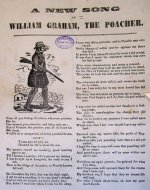 where Len Irving claims that the Lish Young Buy a Broom was written by William Graham. I am that very Sue Allan (not Allen, please note, Matthew!) who produced the first vinyl and wrote notes for both that and the subsequent Veteran CD. And I'm still researching and writing about, singing and playing songs and tunes from the old counties of Cumberland and Westmorland which now make up the county of Cumbria.
Roly Brown refers to the William Graham broadside in Carlisle library in his article, and in fact I reproduced the image of the man with the gun from that broadside in the sheet of notes on songs and singers enclosed with the 1983 Pass the Jug Round vinyl. I attach a photo of the broadside here.
Copies of the Lish Young Buy a Broom can be found in the Bodleian broadside ballad collection, published by Harkness of Preston, dated between 1840 and 1866. But it's impossible to say who wrote the song. What is certain is that it was still being sung enthusiastically not only in 1954 by Len Irving and his cronies, but by many people in Cumbria up to and including the present day ... both in a self-conscious 'folk' context (sessions and clubs) and in an unselfconscious 'traditional' context (hunt meets and shepherds meets). Conclusion: it's just a bloody good song!
With best wishes,
Sue Allan - 6.1.07
Wigton, Cumbria
Correspondence:
| Top of page | Home Page | Articles | Reviews | News | Map |
Site designed and maintained by Musical Traditions Web Services Updated: 12.12.07